
Every guide on topical authority SEO says the same thing: “cover your topic comprehensively.” None of them tell you what comprehensive actually means in measurable terms.
Our semantic SEO guide introduces topical authority as one of four pillars (entity optimization, topical authority, semantic content structure, and structured data). This article is the build-and-measure guide. It covers how Google actually infers topical authority from your content, how to plan what you publish using corpus analysis instead of keyword volume, how to measure whether it’s working with metrics you can run yourself, and how to reinforce topic signals with mainEntityOfPage schema.
Start with the mechanism. Then build on it.
How Does Google Actually Infer Topical Authority?
Google doesn’t expose a “topical authority score.” No API returns it. No Search Console report tracks it. Topical authority is an emergent property – the result of multiple signals that Google’s ranking systems evaluate together.
Those systems are rooted in information retrieval, the academic field where Google’s engineers publish and hire. Understanding the signals means understanding what IR systems actually measure when they assess whether a source covers a subject.
Three signals do the work.
Entity coverage breadth – and relationship depth. Google’s NLP models extract entities from every page you publish. But entity presence alone isn’t the signal. Relationships between entities are.
Google’s Knowledge Graph stores knowledge as subject-predicate-object triples. “Topical authority” by itself is a node – an entity with no context. “Topical authority is inferred from entity coverage breadth” is a triple. It has a subject, a predicate, and an object. That triple carries meaning. The node doesn’t.
This maps to Entity-Attribute-Value modeling – a data structure where each entity is defined by its attributes and their values. A site that defines what its entities are, how they relate to each other, and what attributes each one has covers more of a topic’s semantic territory than a site that just mentions the same terms.
A concrete example. A page about topical authority that mentions “internal linking” has placed one node. A page that states “internal linking density between entity-related pages signals topical relationships to Google’s crawler” has constructed a triple – subject (internal linking density), predicate (signals), object (topical relationships). Google’s models parse the second version into structured meaning. The first version is a keyword occurrence.
This is what entity SEO looks like at the site level. Each page contributes entities and relationships. The sum of those contributions across your site is what Google evaluates as topical coverage.
Internal link density between related content. Links between pages that share entities tell Google those pages are topically connected. When Google’s crawler follows a link from page A to page B and finds overlapping entities in both the anchor text and the destination content, it registers a three-point semantic signal: the source page’s entity context, the anchor text’s description of the relationship, and the destination page’s entity coverage. Generic “related posts” links skip the first and second points entirely.
Volume doesn’t matter here. Ten contextual links between pages that share entity relationships outperform fifty sidebar widget links. The signal is entity co-occurrence across linked pages, not link count.
Pages with no internal links to or from entity-related content are invisible as part of a cluster. Google’s crawler follows links to discover relationships. If the link doesn’t exist, neither does the relationship – at least not in Google’s graph.
Publishing consistency within a topic. Google’s ranking systems evaluate content at both the page level and the site level, as described in its documentation on how search works. That site-level evaluation includes whether a domain demonstrates sustained, deepening coverage of a subject. Not a one-off post. Not a burst of ten articles in a week followed by silence.
Consistency isn’t publishing frequency. It’s whether each new page extends your entity map or duplicates what you’ve already covered. A site that publishes one page per week, each targeting a distinct entity within its topic, builds topical authority faster than one publishing daily across unrelated subjects.
The mechanism is clear. The next question is practical: how do you decide what to publish so each page actually extends your topic coverage instead of repeating it?
What Does a Corpus-Based Content Strategy Look Like?
Most topic planning starts with a keyword tool. You type in a seed term, sort by volume, and build a content calendar around the numbers.
A corpus-based content strategy starts somewhere else entirely. Instead of asking “which keywords have volume,” you ask “which entities does the existing SERP corpus cover – and which ones does it miss?”
Keyword research tells you what people search for. Corpus analysis tells you what’s already been said about it, and where the gaps are. Those gaps are where topical authority builds.
How Do You Map the Entity Territory of a Topic?
Start with the SERP, not a spreadsheet. Pull the top 10 ranking pages for your target topic. Run each page through entity extraction – Google’s Cloud NLP API (which has a free demo interface you can paste text into without writing code), or any NLP model that returns named entities with types and salience scores.
One filtering note: the Cloud NLP API returns both PROPER entities (named things like “Knowledge Graph” or “Google”) and COMMON entities (generic terms like “content” or “pages”). Filter to PROPER, ORGANIZATION, PERSON, CONSUMER_GOOD, and other specific types. Keeping COMMON entities floods your list with noise that dilutes every metric downstream.
Compile every entity extracted across all 10 pages into a single list. That list is the entity territory of your topic. It’s the set of concepts that the current SERP collectively defines as relevant.
Now sort that list by frequency. Entities that appear in 7 or more results are table stakes – you must cover them. Entities that appear in only 1-2 results are differentiation opportunities. Entities that appear in zero results but clearly belong to the topic are information gain opportunities. That last category is where you win.
A practical workflow:
- Pick a target topic. “Topical authority SEO.”
- Pull the top 10 organic URLs for that query.
- Run each URL’s content through entity extraction. Record entity name, type, and salience.
- Build the union set. Deduplicate by Knowledge Graph MID, not by entity name string – the API may return “SEO” and “Search engine optimization” as separate surface forms that resolve to the same entity.
- Count frequency. How many of the 10 pages mention each entity?
- Flag the gaps. Which entities does no one – or almost no one – cover?
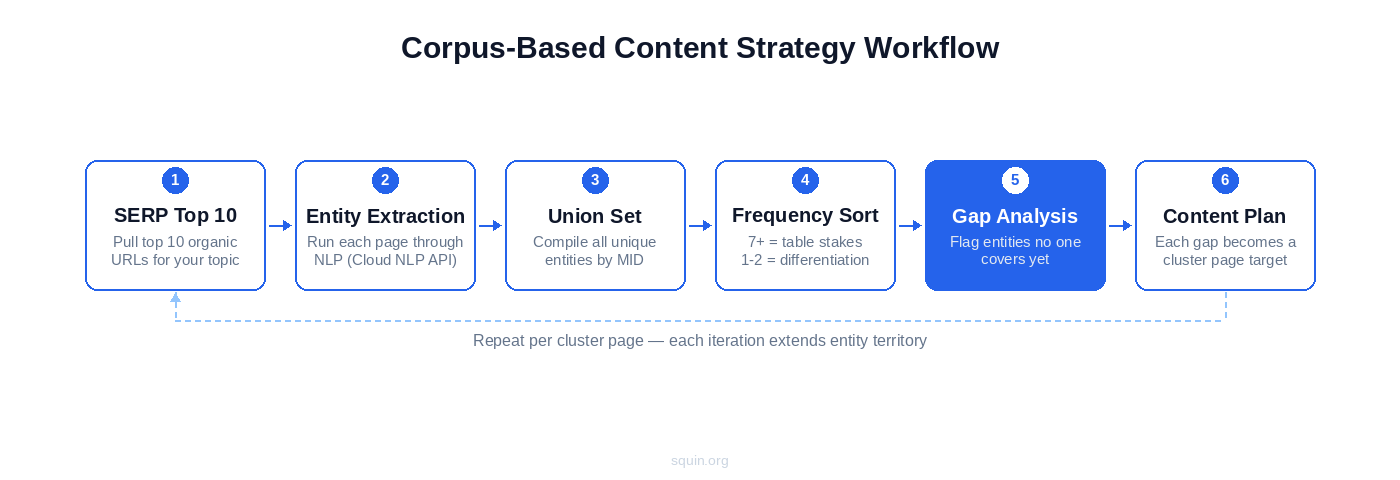
When I ran this process for the topic you’re reading about now, every top result covered entity coverage, internal linking, and content clusters. None covered information gain scoring, Entity-Attribute-Value modeling, or mainEntityOfPage schema implementation. Those gaps became sections in this article.
A keyword tool would have told me “topical authority” gets a certain number of monthly searches. Corpus analysis told me what the top results were missing – and gave me specific entities to build around.
Your entity map translates directly to site architecture. Whether you organize content as topic clusters or content silos, each page in the structure should own a distinct entity or entity relationship from your map. No two pages should target the same primary entity.
How Does Information Gain Score Affect What You Publish?
Google’s Information Gain Patent (US 10,664,534) describes a system that calculates how much new information a document provides relative to documents a user has already encountered for that query. The concept of information gain originates in decision tree theory and information theory. Google’s patent applies the same principle to search: documents that add information not present in the existing indexed corpus receive a higher information gain calculation. Documents that repeat what already ranks receive a lower one.
The information gain score SEO implication is direct. If you publish a cluster page that covers the same entities, in the same depth, as three pages already ranking – you’ve added volume, not value. Google’s system has no reason to prefer your duplicate over the originals.
Flip that. If your page covers entities the existing corpus misses – a specific patent, a measurement framework no competitor defines, a schema implementation no one connects to the topic – your document has high information gain. It adds something to the index that wasn’t there before.
This changes how you plan every piece of content in your cluster. Before writing a new page, audit the SERP corpus for entity gaps. Identify which entities the top results skip. Build your page around those gaps.
Every new cluster page should extend your topic’s entity territory, not duplicate it. That’s how topical authority grows. You’re not just publishing more content about a subject. You’re adding to the total information available about it – and Google’s systems measure that addition.
The strategy tells you what to build. The next question is how to measure whether what you’ve built is actually registering as topical authority in Google’s systems.
How Do You Measure Topical Authority With Real Metrics?
Most guides on topical authority skip measurement entirely – or point you to a proprietary tool score that you can’t audit, reproduce, or understand.
You need topical completeness metrics you can run yourself, using data you already have access to. Three metrics form the stack: query cluster impressions in Google Search Console, entity coverage ratio against the SERP corpus, and semantic coverage density across your cluster pages. None require a paid tool. All are diagnostic – they tell you what’s working and what’s missing.
Query Cluster Impressions in Google Search Console
Open GSC’s Performance report. Instead of filtering by a single query, build a regex filter that captures your entire topic. In the Performance report, click the Query filter, select “Custom (regex),” and enter a pattern like:
semantic SEO|entity SEO|topical authority|Knowledge Graph|entity disambiguation|structured data SEO
GSC regex is case-insensitive. Apply that filter and track total impressions week over week. Not clicks. Not position. Impressions.
The signal you’re looking for: impression growth on queries you never explicitly targeted with a specific page. When Google starts showing your pages for long-tail variations, related questions, and sub-topic queries that no individual page on your site was written to rank for – that’s topical authority accumulating. Google is associating your domain with the broader concept, not just individual keywords.
A concrete scenario. A cluster with 5 published articles shows impressions for 40 queries across those pages. You publish 3 more articles that fill entity gaps identified through corpus analysis. Four weeks later, total impressions grow to 120 queries – and many of those new queries don’t match any page’s target keyword. The existing pages started ranking for more variations because the new pages strengthened the cluster’s topical signal.
That growth pattern is the most reliable topical authority indicator available for free.
Entity Coverage Ratio and Semantic Coverage Density
Query impressions tell you whether Google is expanding your topic footprint. These two metrics tell you why – or why not.
Entity coverage ratio measures how much of a topic’s entity territory your cluster covers. The formula: unique entities across your cluster pages divided by total unique entities in the topic’s SERP corpus.
Run your cluster pages through entity extraction. Run the top 10 competitor pages for your target topic through the same model. Build the union set of all entities the SERP covers. Then calculate what percentage your cluster accounts for.
If the SERP corpus contains 60 unique entities and your cluster covers 35 of them, your entity coverage ratio is 58%. The 25 entities you don’t cover are your content gaps – specific targets for new cluster pages.
Semantic coverage density measures depth without redundancy. It’s the count of unique entities per page across your cluster. A 10-page cluster that collectively covers 40 unique entities has a density of 4.0 entities per page. A 10-page cluster covering 15 entities has a density of 1.5. Higher density means each page contributes distinct entity coverage rather than repeating what sibling pages already define.
Both metrics are relative to your SERP corpus, not absolute. A density of 2.0 could be strong for a narrow topic and weak for a broad one. Use them to compare against your own SERP, not against a universal benchmark.
Both metrics require entity extraction. Google’s NLP API for SEO walks through the full extraction workflow, including how to interpret salience scores and compare entity lists across pages.
These aren’t vanity numbers. They’re diagnostic. A low entity coverage ratio tells you exactly which entities are missing from your cluster. Low semantic coverage density tells you which pages are too thin – covering entities other pages already handle instead of contributing something new.
What Signals Tell You It’s Working?
The metrics above are inputs. These outcomes confirm it’s registering:
- Ranking for queries you didn’t target. The clearest signal. Your existing pages start capturing impressions and clicks for variations, long-tail questions, and sub-topic queries that no individual page was written for.
- Rich result appearances expanding across multiple cluster pages. One page generating a rich result is schema validation. Multiple pages across a cluster generating them signals that Google is reading your entity declarations with increasing confidence at the topic level, not just the page level.
- Faster indexing for new cluster pages. Practitioners frequently report that new pages added to established topic clusters get indexed in hours instead of days. This aligns with how Google allocates crawl resources to sites it considers authoritative on a subject.
- Knowledge Panel appearance for your brand or author entity. This is a separate concern from page-level topical authority, but it’s correlated. Strong topical signals across a cluster reinforce the entity signals that trigger Knowledge Panels.
Track these alongside the diagnostic metrics. Diagnostics tell you what to fix. Outcomes tell you it’s working.
Measurement tells you where you stand. The next question is structural: how do you reinforce those topical signals at the schema level so Google doesn’t have to infer your entity coverage – you declare it explicitly?
How Does mainEntityOfPage Reinforce Topic Signals?
Your content implies which entities each page covers. Your schema confirms it. The mainEntityOfPage schema implementation is how you make that confirmation explicit at the cluster level.
mainEntityOfPage is a schema.org property that declares which page is the canonical resource for an entity. When every page in your cluster declares its own mainEntityOfPage, you’re giving Google a machine-readable entity map of your entire topic structure.
Two additional properties do the entity-level work: about and mentions. The distinction between them matters.
about declares the core entity this page exists to define. It’s the node this page owns in your topic’s entity territory. Each cluster page should have one about entity – the primary subject that page covers more thoroughly than any other page on your site.
mentions declares the peripheral entities that appear in the content but aren’t the primary subject. These are the edges. They connect this page to sibling topics in your cluster. A page about topical authority mentions the Knowledge Graph, information gain, and JSON-LD – but it’s about search engine optimization at the topical authority level. The mentions array maps those connections explicitly.
This maps directly to the corpus-based entity territory from the previous sections. Your about property corresponds to the entity gap this page was built to fill. Your mentions properties correspond to the related entities that contextualize it within the cluster.
A working example for this page:
{
  "@context": "https://schema.org",
  "@type": "Article",
  "headline": "Topical Authority: How to Build and Measure It",
  "mainEntityOfPage": {
    "@type": "WebPage",
    "@id": "https://squin.org/semantic-seo/topical-authority-seo/"
  },
  "about": {
    "@type": "Thing",
    "@id": "http://www.wikidata.org/entity/Q180711",
    "name": "Search engine optimization",
    "sameAs": "https://en.wikipedia.org/wiki/Search_engine_optimization"
  },
  "mentions": [
    {
      "@type": "Thing",
      "@id": "http://www.wikidata.org/entity/Q17083041",
      "name": "Information gain",
      "sameAs": "https://en.wikipedia.org/wiki/Information_gain_(decision_tree)"
    },
    {
      "@type": "Thing",
      "@id": "http://www.wikidata.org/entity/Q648625",
      "name": "Knowledge Graph",
      "sameAs": "https://en.wikipedia.org/wiki/Google_Knowledge_Graph"
    },
    {
      "@type": "Thing",
      "@id": "http://www.wikidata.org/entity/Q6108942",
      "name": "JSON-LD",
      "sameAs": "https://en.wikipedia.org/wiki/JSON-LD"
    }
  ]
}
Every @id points to a Wikidata URI. Wikidata URIs are stable, unique identifiers for entities. When Google encounters them, it can resolve your about and mentions declarations directly against Knowledge Graph entries. No ambiguity. No inference.
Note the @id format: http:// (not https) with /entity/ (not /wiki/). That’s Wikidata’s canonical Linked Data URI as specified in their data access documentation.
One practical note if you’re running WordPress with Rank Math: the plugin already generates the mainEntityOfPage wrapper and the Article type automatically. Don’t duplicate those. The about and mentions arrays are what you add – either through the rank_math/json_ld filter in your theme’s functions.php or via Code Snippets. Google’s Article structured data documentation confirms mainEntityOfPage as a recommended property for Article types.
Our JSON-LD tutorial covers the full nesting syntax, @id-based cross-referencing across multiple schema blocks, and validation workflow.
One thing this doesn’t do. Schema alone doesn’t build topical authority. Adding about and mentions to a thin page with no real entity coverage produces a declaration that the content can’t support. Schema reinforces what your content and internal links already establish. It amplifies the signal. It doesn’t create it.
The implementation is straightforward. The mistakes that undermine topical authority are less obvious – and more common.
What Are the Most Common Topical Authority Mistakes?
These show up in every audit. All six are preventable if you catch them before publishing, not after.
Cannibalization from overlapping entity targets. Two pages in the same cluster targeting the same primary entity compete with each other in Google’s index. This isn’t a keyword overlap problem. It’s an entity overlap problem. If two pages both define “topical authority” as their core subject – even with different title tags – they’re fighting for the same about entity. The fix happens before you write: map each page to a distinct primary entity. If your entity map has duplicates, merge the pages or redefine one page’s scope. Keyword research alone won’t catch this. Entity mapping will.
Orphaned cluster pages. A page with zero internal links from sibling content is invisible as part of a cluster. Google’s crawler follows links to discover relationships. No link, no relationship. Every cluster page needs at least 2-3 contextual internal links pointing to and from related pages. Not sidebar widgets. Not “related posts” blocks. Inline links with anchor text that describes the entity relationship between the pages.
Breadth without entity depth. Twenty pages that mention a topic superficially don’t build topical authority. Ten pages that each define specific entities, describe their attributes, and map relationships between them do. Depth means covering entity triples – subject, predicate, object – not just entity names. A page that says “the Knowledge Graph is important for SEO” adds a node. A page that explains how Google resolves entities against Knowledge Graph entries using NLP extraction and sameAs signals adds triples. The second page contributes to topical depth. The first is filler.
Chasing keyword volume instead of entity coverage. A high-volume keyword where the top 10 results already cover every relevant entity gives you nothing to gain. The SERP is saturated. A low-volume query where no competitor covers a critical entity – that’s where topical authority accumulates. Corpus analysis identifies these entity gaps. Keyword volume hides them.
Ignoring information gain. If your new cluster page covers the same entities, in the same depth, as three pages already ranking – you’ve added a URL, not information. Audit the SERP corpus before you write. Identify what’s missing. Build around the gaps.
Treating schema as separate from content strategy. Adding about and mentions properties to a 300-word page that barely defines its primary entity produces a declaration the content can’t support. Schema confirms what exists. It doesn’t create what doesn’t. Build the entity depth in your content first. Then declare it in your markup. That sequence matters.
Frequently Asked Questions
What is the 80/20 rule for topical authority?
Cover the 10-15 entities that define your topic’s core. Create a page for each one. Link them together with contextual internal links. Add about schema declarations to each page pointing to the correct Wikidata URI. That covers roughly 80% of the topical signal. The remaining 20% comes from entity disambiguation, advanced schema patterns, information gain optimization, and entity-aware link building – each covered in dedicated guides across this site.
How long does it take to build topical authority?
Depends on topic scope and competition. A narrow topic with 10-15 cluster pages can show GSC impression growth in 8-12 weeks. A broad topic with established competitors takes longer. The signal is coverage-based, not time-based. Publish entity-complete content that fills real corpus gaps and it compounds faster than publishing on a fixed editorial calendar regardless of content quality.
Can you measure topical authority with a tool?
Semrush offers a proprietary topical authority metric. No free tool exposes a topical authority score directly. The measurement framework in this article – query cluster impressions, entity coverage ratio, semantic coverage density – gives you an independent stack you can run using GSC and any NLP API. It doesn’t depend on a single vendor’s scoring model, and you can audit every input.
Does topical authority replace backlinks?
No. Backlinks remain a ranking signal. Topical authority is a separate signal that compounds your existing link authority. A site with strong topical coverage and strong backlinks outperforms one with only one or the other. They’re complementary. Not substitutes.
What’s the difference between topical authority and domain authority?
Domain authority is a third-party metric from Moz and Ahrefs that estimates a domain’s overall link strength. It’s a number those tools invented. Google doesn’t use it. Topical authority is Google’s assessment of how comprehensively a site covers a specific subject – inferred from entity coverage, internal linking, and publishing consistency. You can have high domain authority and zero topical authority on a given topic. The reverse is also true.
Where This Fits
Topical authority is one of four pillars in the semantic SEO framework. The entity-level foundation it depends on – how Google identifies and resolves entities across your content – is covered in What Is Entity SEO?. The architecture model you build it on, whether topic clusters or content silos, has its own dedicated guide.