
Semantic keywords aren’t synonyms. They aren’t “related terms” from a keyword tool’s sidebar. They’re the entities and concepts that define a topic – the terms Google’s NLP models expect to find when a page claims to cover a subject with depth.
This guide covers the mechanics behind why they work, a research process built on entity extraction instead of keyword tools, and a validation workflow using Google’s own NLP API. If you need the broader context of how semantic keywords fit into semantic SEO, start with the pillar.
What Are Semantic Keywords – and What Are They Not?
A synonym for “car” is “automobile.” A semantic keyword for “car” is “horsepower,” “drivetrain,” or “NHTSA.” Different relationship entirely.
Synonyms are lexical substitutions – different words for the same thing. Semantic keywords are conceptually related entities and terms that signal you actually understand a topic. They don’t replace your target keyword. They surround it with the concepts that give it meaning.
When Google’s NLP models parse a page about “car safety,” they extract entities: NHTSA, crash test ratings, crumple zones, IIHS, airbag deployment. A page that covers those entities demonstrates topical depth. A page that mentions “car safety” fourteen times and none of those entities demonstrates keyword repetition. Google’s models can tell the difference.
One myth needs to die. “LSI keywords” is not a synonym for semantic keywords. Latent Semantic Analysis is a matrix decomposition technique from 1988 – it computes word co-occurrence patterns across a term-document matrix using singular value decomposition. Google doesn’t use it. Google runs transformer-based models that produce contextual word embeddings, where every word is processed in relation to every other word in the passage simultaneously. LSA and BERT aren’t different versions of the same approach. They’re different architectures solving the problem in fundamentally different ways. The term “LSI keywords” survives in SEO content because nobody corrected it at scale. Consider it corrected.
The distinction that matters for your workflow: semantic keywords prove you understand a topic at the entity level. Google’s NLP models extract entities from your text and assess whether the page covers the concepts that define the subject. Missing those concepts – even if your target keyword appears in every heading – signals shallow coverage to the models evaluating your page.
That raises a practical question. Why do these entity-level concepts register with Google’s ranking systems at all? The answer is in how language models represent meaning mathematically.
Why Do Semantic Keywords Work? The NLP Mechanics
Every SEO guide says “Google understands context.” None of them explain the mechanism. The mechanism matters, because it tells you exactly why covering related entities improves your rankings – and why repeating your target keyword doesn’t.
How Word Embeddings Represent Meaning
Google’s language models convert every word and phrase into a vector – a list of hundreds of numbers that represent that term’s meaning as a point in high-dimensional space. These are word embeddings.
The principle behind them is distributional semantics: words that appear in similar contexts carry similar meanings. “Horsepower” and “torque” show up in similar contexts across billions of documents. Their vectors are close together. “Horsepower” and “kindergarten” don’t. Their vectors are far apart.
Google measures the distance between vectors using cosine similarity – a calculation that compares the angle between two vectors regardless of their magnitude. Two documents can share zero keywords and still register as semantically close because their underlying entity patterns produce similar vector representations. That’s cosine similarity for content in practice.
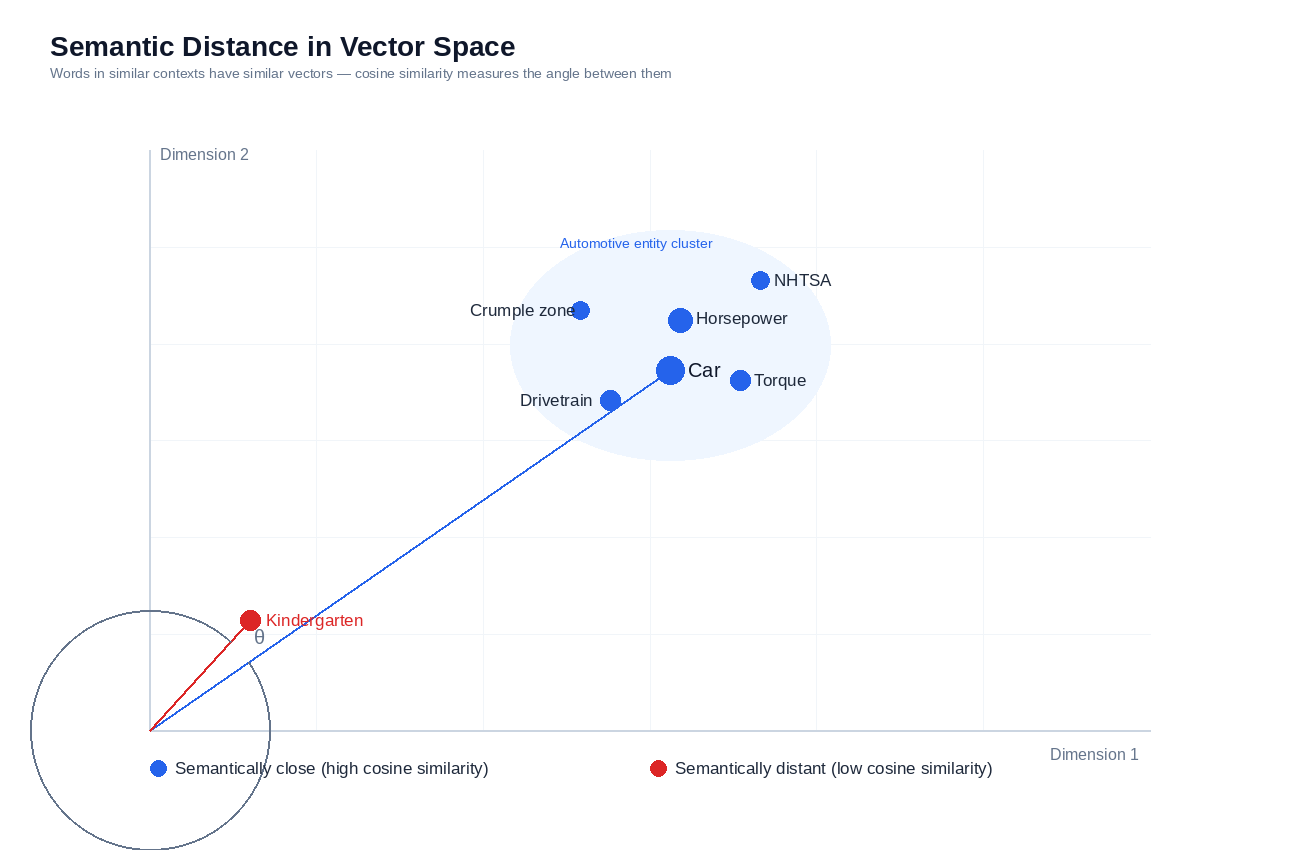
This is why semantic keywords work at the model level. When you write about “schema markup” and cover JSON-LD, rich results, Google Search Console, and validation errors, your page’s embedding moves closer to the query embedding for “schema markup” in vector space. Each related entity you cover shifts the vector. Each one you miss leaves a gap between your content’s position and where the query sits.
Word embeddings also explain why keyword repetition doesn’t help. Repeating “schema markup” twenty times doesn’t change which entities your page covers. The vector barely moves. Covering the entities that define the topic – the ones that appear in similar contexts across Google’s training corpus – moves it substantially.
After BERT’s 2019 rollout, this shifted from theory to infrastructure. BERT processes every word in context with every other word in the passage simultaneously. Google reported it affected one in ten English searches at launch. By late 2020, Google indicated BERT-based language understanding applied to nearly all English queries. The current stack extends beyond BERT – MUM, Gemini, and other models build on the same transformer foundation that powers Google’s understanding of both queries and content. Your content isn’t evaluated word by word anymore. It’s evaluated as a semantic unit – and the entities present in that unit determine where it lands in vector space.
What Content Optimization Tools Actually Measure
When Surfer SEO flags “missing terms” or Clearscope shows you a content score, those tools are identifying semantic keywords through some model. The question is which model – because they don’t agree.
Three scoring paradigms power every content optimization tool on the market:
TF-IDF analysis is the legacy approach. The tool counts how often specific terms appear in top-ranking pages and scores your content against those frequency distributions. TF-IDF surfaces the terms that distinguish one document set from another – and some of those terms are entity names. But it can’t distinguish between an entity mention and a generic word, and it can’t assess whether your content covers the concept behind a term or just repeats the string. Most tools still default to this mode.
NLP entity extraction is the middle tier. Tools like Clearscope run your content through an NLP model and compare the entity lists against what top-ranking pages contain. This measures whether you’ve covered the same named entities and concepts. Harder to game than term frequency because you can’t satisfy it by repeating strings. You need to actually cover the entities.
LLM-based embeddings represent the current frontier. These tools convert your content into vectors and measure semantic similarity through cosine distance. MarketMuse, Surfer’s NLP engine, and NeuronWriter all use transformer-based models at this level now. They don’t compare your content directly against the top-ranking pages. They compare it against a model built from those pages. That’s a meaningful distinction when you’re interpreting the output.
The practical implication: a score of 85 in Surfer and 85 in Clearscope reflect two different assessments using two different definitions of relevance. Knowing which model produces the score changes how you interpret it. Our [Surfer SEO vs Clearscope comparison] (coming soon) tests both tools on the same content and compares their outputs side by side.
Use these scores to find what’s missing in your content. Don’t chase the number itself. The score is a diagnostic, not a target.
The mechanics explain why semantic keywords matter. The next question is practical: how do you find the right ones for your topic?
How Do You Find Semantic Keywords Using Entity Extraction?
Entity extraction gives you the concepts that define a topic – with types, salience scores, and Knowledge Graph IDs you can verify. That’s a fundamentally different starting point from typing a keyword into a tool and scanning the “related terms” sidebar.
Start From the Entity, Not the Keyword
Don’t start with a seed keyword. Start with the core entity your page covers. Then map outward.
Identify the entity. What related entities define this topic? What attributes does each entity have? What relationships connect them?
For this article, the core entity is semantic keywords – grounded in distributional semantics. The related entities: word embeddings, named-entity recognition, Knowledge Graph, cosine similarity, TF-IDF. Each of those entities generates terms and concepts your content should cover. That’s your semantic keyword list – derived from entity relationships, not keyword tool suggestions.
The extraction method that makes this concrete is Named Entity Recognition (NER). NER is an NLP task that identifies named entities in text – people, organizations, concepts, places – and classifies them by type. When you run a page through an NER model, you get a structured list: entity name, entity type, salience score, and (where the model can match it) a link to the entity’s Knowledge Graph entry. That structured list is your research output. Not a keyword list. An entity map.
Four Sources for Semantic Keyword Research
Google’s Cloud NLP API is the most direct source. You send it text. It returns every entity it identifies, each with a type, a salience score, and – critically – a MID (Machine Identifier). The MID is the unique ID for that entity’s node in Google’s Knowledge Graph. /m/02mjmr is “Semantic Web.” /m/045c7b is “Google.” /m/0dl567 is “Apple Inc.”
A semantic keyword is the human-readable label for a specific Knowledge Graph node. The practitioner-level research move: run your competitors’ top-ranking pages through the Cloud NLP API and check which entities resolve to which MIDs. If your page about Apple the company triggers /m/0k8z (the fruit) instead of /m/0dl567 (the company), your semantic keyword coverage isn’t disambiguating the core entity. That’s keyword research validated at the Knowledge Graph ID level.
Copy the visible body text from your competitor’s page – exclude navigation, headers, footers, and sidebar content. The API accepts plain text, not HTML. Then run this call:
curl -s -X POST \
  "https://language.googleapis.com/v1/documents:analyzeEntities?key=$GOOGLE_API_KEY" \
  -H "Content-Type: application/json" \
  -d '{
    "document": {
      "type": "PLAIN_TEXT",
      "content": "Paste your competitor page text here"
    },
    "encodingType": "UTF8"
  }' | jq '.entities[:5]'
The response returns an array of entities sorted by salience. Each entry looks like this:
{
  "name": "Knowledge Graph",
  "type": "OTHER",
  "salience": 0.187,
  "metadata": {
    "mid": "/m/0bs2j8q",
    "wikipedia_url": "https://en.wikipedia.org/wiki/Google_Knowledge_Graph"
  },
  "mentions": [
    {
      "text": { "content": "Knowledge Graph", "beginOffset": 412 },
      "type": "PROPER"
    }
  ]
}
The fields that matter: name is the entity label. type classifies it (PERSON, ORGANIZATION, OTHER, etc.). salience scores its prominence on the page. metadata.mid is the Knowledge Graph identifier – if present, Google resolved the entity to a known node. Entities without a mid are ones Google recognizes in the text but can’t connect to its graph. Those still matter as semantic keywords, but the ones with MIDs are confirmed Knowledge Graph entities.
When you extract 100+ entities across five competitor pages, you’ll get noise. “Tuesday,” “PDF,” and “Google” will appear alongside your actual topical entities. Filter by salience (drop anything below 0.01), filter by type (keep ORGANIZATION, EVENT, WORK_OF_ART, OTHER for concept entities – drop COMMON nouns and NUMBER types), and prioritize entities that appear across multiple competitor pages. An entity that shows up on four out of five top-ranking pages with consistent MIDs is a strong semantic keyword candidate. One that appears once with low salience is likely noise.
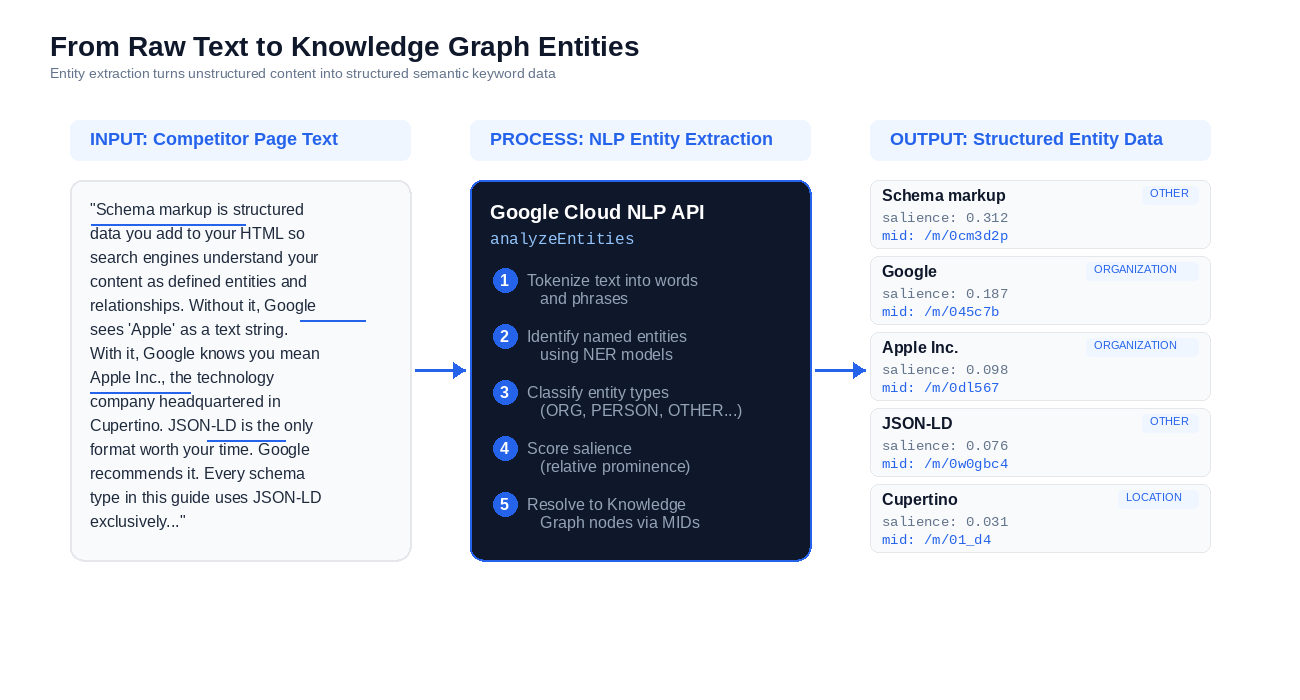
Google’s Knowledge Graph Search API works the other direction. Instead of extracting entities from text, you query an entity name and get back related entities, types, descriptions, and MIDs. Useful for mapping outward from your core entity to discover what else the Knowledge Graph associates with it.
curl -s "https://kgsearch.googleapis.com/v1/entities:search?query=semantic+web&key=$GOOGLE_API_KEY&limit=3&indent=true"
The response returns matching entities with their @id (Knowledge Graph URI), name, description, and a detailedDescription field containing the Wikipedia URL. You can use this to verify that your target entity resolves to the correct Knowledge Graph node and to discover related entities you haven’t considered.
SERP entity analysis is the gap-finding method. Run your content and your top competitors’ content through the NLP API. Compare the entity lists. Every entity they cover that you don’t is a candidate semantic keyword. The gap between their entity coverage and yours is your research output.
People Also Ask and Related Searches surface the questions and concepts users associate with your topic. Each PAA question implies an entity or a relationship your content might need to cover. These won’t give you MIDs or salience scores, but they reveal how real users connect concepts within your topic space.
The standard approach – type a keyword into Semrush, scan the related terms – gives you strings that share words with your target. Entity extraction gives you concepts that share meaning with your target, verified against Knowledge Graph IDs. One finds words. The other finds entities. Build your list from entities.
You have a list of semantic keywords grounded in entity extraction. The next step is turning that list into content structure – mapping entity clusters to headings and sections.
How Do You Map Semantic Keywords to Content Structure?
Your entity map is your outline. Not a metaphor. The entity clusters you extracted in the previous step become your H2 headings. The related entities within each cluster become your H3s. The semantic keyword list doesn’t feed into your content structure – it is your content structure.
Keyword clustering algorithms group semantically related terms into clusters based on vector similarity or co-occurrence patterns. Each cluster represents a subtopic dense enough to deserve its own section. When you’ve extracted thirty semantic keywords for a topic, you don’t scatter them across paragraphs. You group them by entity relationship, and each group becomes a content section with a specific heading.
N-grams in SEO make this sharper. A 1-gram like “Apple” is ambiguous – fruit, company, record label. A 5-gram like “Apple iPhone 15 Pro Max” resolves to a single entity with zero ambiguity. Longer N-gram patterns function as contextual anchors that lock your core entity into the correct Knowledge Graph node. Your content structure should include these longer, more specific phrases as headings and subheadings, not just single-word entity names buried in body text. The more specific the N-gram, the less inference Google needs to disambiguate.
This article demonstrates the principle directly. The definition section maps to the entity “distributional semantics.” The NLP mechanics section maps to “word embeddings” and “cosine similarity.” The research section maps to “named-entity recognition.” Each H2 exists because an entity cluster demanded it.
Internal linking follows the same logic. Each entity cluster that has its own dedicated page on your site becomes an internal link from the section that covers it. This is how semantic keyword research feeds topical authority – every cluster article covers entities the pillar introduces, and the links between them tell Google those relationships are real. Co-occurring semantic keywords reinforce this further. Writing “Mercury” alongside “orbit,” “atmosphere,” and “NASA” disambiguates toward the planet without any explicit declaration. The entity context does the work. Our guide on entity disambiguation covers the full signal set.
Structure mirrors entities. Get the entity map right and the content architecture follows. The remaining question is whether Google’s models actually extract what you intended – and that requires validation.
How Do You Validate Semantic Keyword Coverage?
You’ve built your semantic keyword list. You’ve mapped it to content structure. You’ve written the draft. Did it work? Run the same analyzeEntities call from the research step, this time with your full draft as the content value. Check three things in the output.
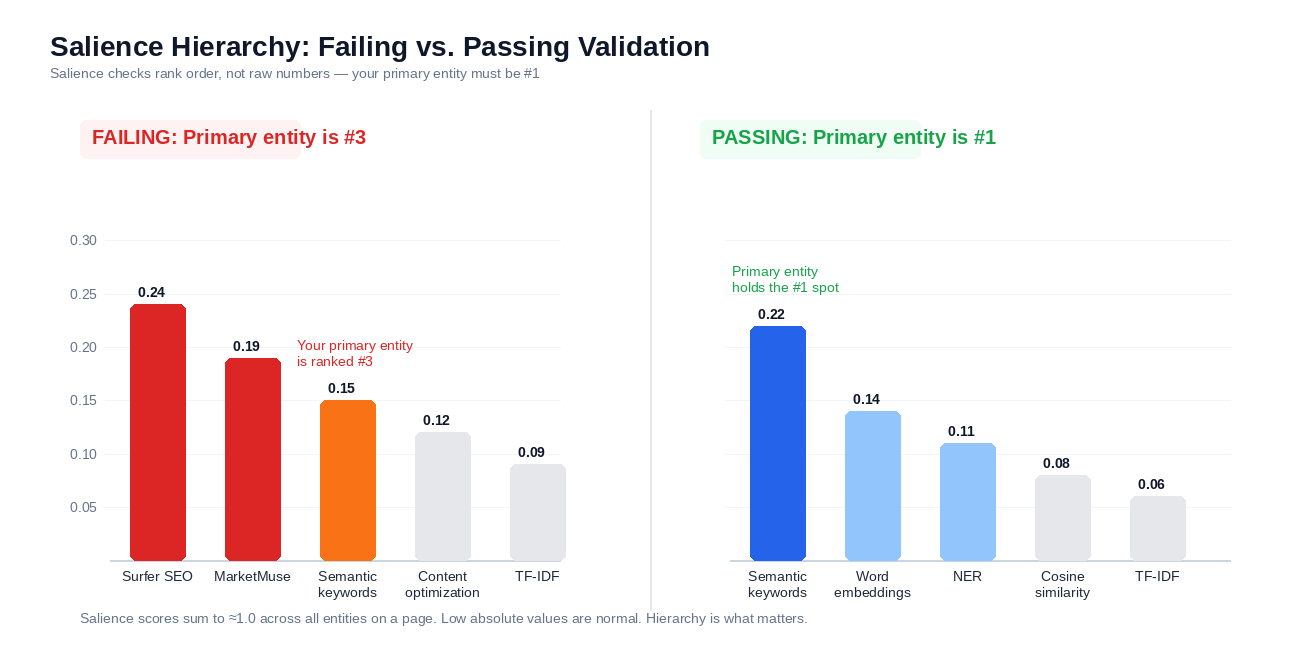
First, salience hierarchy. Your primary topic entity should hold the highest salience score on the page – not a high score in absolute terms, but higher than everything else. On a 2,000-word page covering dozens of entities, your core topic might score 0.12. That’s normal. It’s only a problem if three other entities score higher. If a tool name you mentioned twice outranks the topic you wrote 2,000 words about, your content is giving it more prominence than your subject. Validation checks rank order, not raw numbers.
Second, entity presence and MID accuracy. Do the semantic keywords from your research appear in the extraction? Do they resolve to the correct MIDs? If you wrote about Apple Inc. and the API returns /m/0k8z (the fruit), your co-occurring entities aren’t disambiguating the way you expected. Missing entities are gaps. Wrong MIDs are worse – they mean Google is connecting your content to the wrong Knowledge Graph node.
Third, competitive gap analysis. Run the extraction on the top-ranking page for your target query. Export both entity arrays – yours and theirs – to a spreadsheet. Sort by salience. Diff the entity name columns. Every entity in their list that’s absent from yours is a semantic keyword you may need to add. Every entity you cover that they don’t is potential differentiation – or noise you should evaluate.
Content optimization scores from tools like Surfer or Clearscope work as a secondary check. They flag missing concepts faster than manual API calls. But each tool runs a different model, and a score of 85 in one doesn’t mean the same thing as 85 in another. Use them to spot gaps. Don’t treat the score as the target.
The loop is iterative. Write, extract, compare, revise. Run the API again after revisions. This is the closest thing to a test suite for semantic keyword coverage – and it connects directly to a broader [semantic SEO audit] (coming soon) that checks entity coverage at the site level, not just the page level.
Validation catches what’s missing. The next section covers the mistakes that put wrong signals in your content in the first place.
Common Mistakes With Semantic Keywords
Treating semantic keywords as a density target. Repeating “Knowledge Graph” twelve times doesn’t increase its salience. Writing about its attributes – how it stores entities, how Google resolves ambiguity against it, how sameAs links connect to it – does. Salience comes from context, not frequency. The NLP API proves this every time you run it.
Confusing synonyms with semantic keywords. “Automobile” for “car” is a synonym. “Horsepower” is a semantic keyword. One is lexical substitution – a different word for the same thing. The other signals that you understand what the topic actually involves. Most tools marketed as “semantic keyword” generators return synonyms and close variants. Check whether your tool outputs named entities with types and Knowledge Graph links, or just strings that share words with your target.
Stopping at the keyword tool. Semrush’s “related keywords” gives you lexically related strings. That’s a starting point, not a destination. Entity extraction from competitor pages – through the NLP API or a tool that runs actual NER – gives you the concepts Google’s models look for. The data sources produce different outputs.
Skipping validation entirely. You found semantic keywords. You added them to your content. How do you know Google’s NLP extracted them with the salience you intended? Without running the API or at minimum checking a content optimizer’s entity-level output, you’re guessing. And guessing is what keyword-era SEO looked like.
Chasing content optimization scores instead of entity coverage. A Surfer score of 90 means your content matches one tool’s model of what top-ranking pages contain. It doesn’t mean Google’s models agree. It doesn’t mean your primary entity holds the highest salience. The score is a diagnostic that helps you spot gaps. It’s not a target to optimize toward. Write for entity completeness, then use the score to check your blind spots.
Frequently Asked Questions
What is an example of a semantic keyword?
For a page targeting “schema markup,” semantic keywords include JSON-LD, rich results, Google Search Console, and structured data validation. These are entities and concepts that define the topic. They aren’t synonyms for “schema markup” – they’re the terms Google’s NLP models expect to find on a page that genuinely covers the subject.
Are LSI keywords the same as semantic keywords?
No. Latent Semantic Analysis is a 1988 statistical technique based on singular value decomposition of term-document matrices. Google doesn’t use it. Google uses transformer-based models that produce contextual word embeddings – a fundamentally different architecture. “Semantic keywords” describes the concept correctly. “LSI keywords” describes a technology Google doesn’t run. The term persists in SEO content because it was never corrected at scale.
How many semantic keywords should you use per page?
There’s no target number. The goal is conceptual completeness for your topic. Run your content through entity extraction and check whether the entities that define your subject appear with adequate salience. If your page about “semantic SEO” never mentions entities, structured data, or NLP, those are gaps – regardless of how many other terms you included. Entity coverage matters. Term count doesn’t.
Can you find semantic keywords for free?
Yes. Google’s People Also Ask, related searches, and the Cloud NLP API free tier cover the full workflow. The NLP API returns the same entity extraction output Google’s own models produce – entities, types, salience scores, and Knowledge Graph MIDs. Paid tools add speed and a visual interface. They don’t provide fundamentally different data.