
Traditional link building optimizes for domain authority. Entity-based link building optimizes for something different: how confidently Google can connect your site to a specific entity in its Knowledge Graph.
That confidence doesn’t come from anchor text ratios or PageRank flow. It comes from entity salience – how prominently your target entities appear in the content that links to you.
If you’re still working through the semantic SEO fundamentals, start there. This guide assumes you’re ready to execute. It covers how Google evaluates entity signals in links, why independent corroboration compounds, and how to implement and validate an entity-first link building workflow – with working code.
How Google Evaluates Links Through Entity Signals
Google doesn’t just pass PageRank through a hyperlink. It extracts entities from the linking page, scores their salience, and evaluates whether those entities overlap with the entities on the target page. The link itself is one signal. The entity context surrounding it is another.
This changes how you evaluate link prospects. A page about JavaScript frameworks might be topically relevant to a web development site. But if that page’s highest-salience entity is React and your target entity is structured data, the entity signal carried by that link is weak. The topics overlap. The entities don’t.
What matters are the semantic co-occurrence signals in linking content – two or more entities appearing on the same page in a way that allows Google to associate them. When your brand entity or author entity appears alongside your target topic entities on a third-party page, Google’s confidence in that relationship increases. The linking page isn’t just voting for your URL. It’s confirming an entity-relationship that Google can cross-reference against other sources.
Disambiguation affects this directly. When a linking page references an ambiguous term – “Mercury” could be a planet, an element, or a car brand – Google has to resolve which entity the page means before it can evaluate the entity signal the link carries. If the resolution is wrong or uncertain, the signal weakens. Entity disambiguation is a separate implementation problem, but it shapes how much entity value your inbound links deliver.
Entity Salience – What Google Actually Measures
Salience isn’t frequency. A page that mentions your brand twelve times doesn’t necessarily produce a stronger entity signal than one that mentions it twice. Entity salience scoring measures something closer to proportion – how much of the page’s overall meaning does a given entity account for?
Your brand mentioned once inside a 3,000-word article covering fifteen topics? Low salience. Your brand is the primary subject of a focused 500-word section? High salience. Same entity, different signal strength.
The Google Cloud Natural Language API returns salience as a score between 0 and 1 for every entity it extracts from a page. That score gives you a concrete, measurable way to evaluate whether a linking page actually carries entity signal for your targets – or just happens to share a topic. You’ll use this measurement in the implementation playbook to score link prospects before outreach and validate results after.
Knowledge Graph Corroboration – Why Independent Sources Compound
Knowledge Graph corroboration is a useful frame for a pattern visible in Google’s behavior and supported by patent filings like US9213748B1: entity-relationships that appear across multiple independent, uncoordinated sources receive higher confidence scoring. One guest post associating your author entity with “structured data” is a data point. Five independent sites making the same association – without coordinating – is a pattern that gets treated as reliable. The confidence increase isn’t linear. It compounds.
The measurable output of this compounding is an aggregate trust signal that emerges when multiple sources independently confirm the same entity-relationship. Traditional link building counts how many sites link to you. Corroboration measures how consistently different sources associate your entity with the same topic entities.
This reshapes how you prioritize. Five links from five independent sites that all associate your author entity with “structured data” and “semantic SEO” create stronger corroboration than twenty links from sites that mention your brand without entity context. Volume without entity consistency doesn’t compound.
Unlinked brand mentions carry signal here too. A co-occurrence of your entity with a target topic entity on an authoritative page contributes to corroboration even without a hyperlink. The hyperlink adds PageRank. But the entity signal – the confirmation that Source X associates Entity A with Topic B – exists independently of whether the mention is linked. This is why unlinked brand mentions SEO is a core component of entity-based link building, not an afterthought. The entity relationship is already recorded. The link makes it stronger.
The Implementation Playbook
The concepts described above translate into a three-phase workflow: prospect by entity overlap, build links that carry entity signal, and structure them for compounding effect.
Prospecting Through Entity Overlap
Stop sorting link prospects by Domain Authority. Sort them by entity overlap with your target page.
First, define your target entity profile. Run your own target URL through the NLP API script below and record every entity with salience above 0.05. Run the top three ranking competitors for your target query through the same script. The union of these entity lists – your page’s entities plus the entities Google already associates with the topic – is the profile you prospect against.
The workflow uses Google’s Natural Language API – the same NLP pipeline covered in how Google’s NLP processes content. You feed it a candidate linking page’s content and get back every entity Google extracts, along with a salience score between 0 and 1 for each. Entity salience scoring at this stage is your primary filter – it replaces DA as the deciding metric for whether a prospect is worth pursuing.
Compare the extracted entities against your target entity profile. Prioritize candidates where your target entities appear with salience above 0.1. That threshold isn’t arbitrary. Below 0.1, the entity is present but peripheral – a passing mention in a page dominated by other topics. Above 0.1, the entity contributes meaningfully to what the page is about. A score above 0.3 often means the entity is central to the content – but salience is relative to document length and entity count. A 5,000-word page with 200 entities distributes salience differently than a 500-word page with five. Treat these thresholds as starting points, not absolutes.
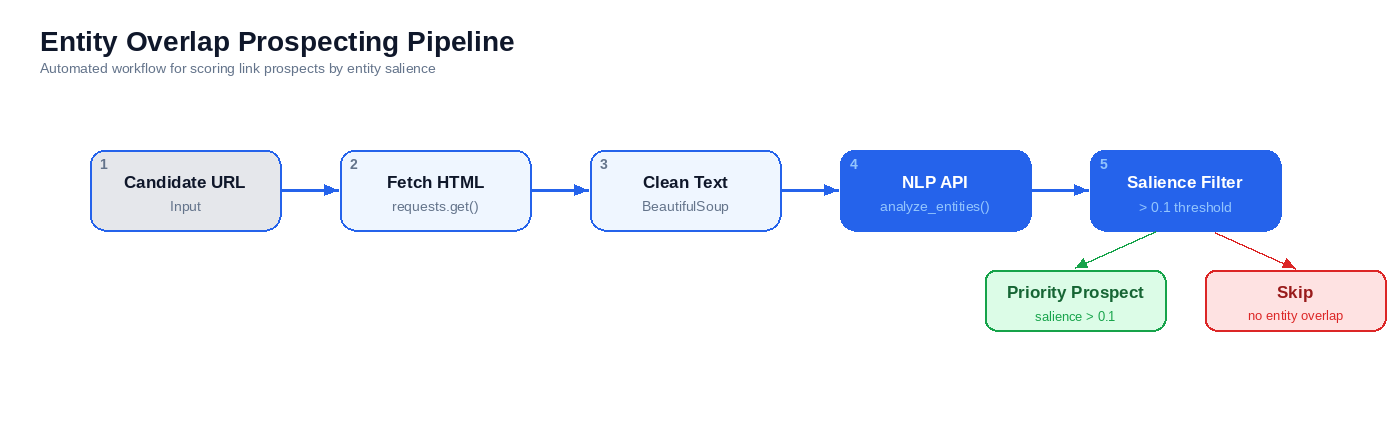
Setup: install the google-cloud-language and beautifulsoup4 packages, then set up a Google Cloud Natural Language API key.
from google.cloud import language_v1
from bs4 import BeautifulSoup
import requests

def get_entity_salience(url, min_salience=0.1):
    """Extract entities and salience scores from a URL's visible text.
    Note: text is truncated to 5,000 characters to stay within API limits.
    For pages over ~1,500 words, entities mentioned only in later sections
    may not appear in results. Run long pages in segments if link context
    matters and sits deep in the content."""
    # Fetch and clean page content - raw HTML sends CSS/JS noise to the API
    html = requests.get(url, timeout=10).text
    soup = BeautifulSoup(html, "html.parser")
    for tag in soup(["script", "style", "nav", "footer", "header", "aside"]):
        tag.decompose()
    text = soup.get_text(separator=" ", strip=True)[:5000]

    # Initialize the NLP client
    client = language_v1.LanguageServiceClient()
    document = language_v1.Document(
        content=text,
        type_=language_v1.Document.Type.PLAIN_TEXT
    )

    # Analyze entities
    result = client.analyze_entities(document=document)

    # Filter and sort by salience
    entities = [
        {"name": e.name, "type": e.type_.name, "salience": round(e.salience, 3)}
        for e in result.entities
        if e.salience >= min_salience
    ]
    return sorted(entities, key=lambda x: x["salience"], reverse=True)

# Example: evaluate a candidate linking page
prospects = get_entity_salience("https://example.com/candidate-page")
for entity in prospects:
    print(f"{entity['name']} ({entity['type']}): {entity['salience']}")
Run this against every candidate page. If your target entities don’t appear in the output, the link won’t carry entity signal regardless of the site’s authority metrics.
Building Entity-Relevant Links
Outreach changes when you think in entities. The pitch isn’t “I have great content your readers would love.” It’s specific: “Your article covers entity X but doesn’t reference entity Y. Your readers encounter X in the context of Y, and adding that connection makes the piece more complete.” You’re identifying an entity gap, not selling content.
Three execution paths, in order of effort:
Unlinked brand mention auditing. Search for pages that already mention your brand or author entity alongside your target topic entities – but don’t link to you. These are the lowest-friction outreach targets because the entity relationship already exists in Google’s index. You’re not asking someone to create a new association. You’re asking them to make an existing one explicit with a hyperlink. The entity signal is already there. The link adds PageRank on top of it. Unlinked brand mentions SEO is where entity-based link building starts producing results fastest, because the semantic co-occurrence signals are already in place – you’re just adding the hyperlink layer.
Guest placements with author attribution. When you place content on another site, insist on a bylined author credit with a link to your author page. Anonymous guest posts pass PageRank but don’t feed author entity reconciliation – the process by which Google merges author signals across multiple domains into a single entity profile. Google cross-references author entities across guest posts, social profiles, conference presentations, and citations. Consistency across those sources builds the profile. The byline is the minimum.
If you can get the host site to include Person schema for you as guest author, the link carries entity signal for both the site and the author. Most guest posts don’t include schema for the guest author – the byline is plain text. Structured data removes the ambiguity that name matching alone can’t resolve. A portable Person snippet you can provide to any host:
{
  "@context": "https://schema.org",
  "@type": "Person",
  "@id": "https://yoursite.com/#author",
  "name": "Your Name",
  "url": "https://yoursite.com/about/",
  "sameAs": [
    "https://twitter.com/yourhandle",
    "https://linkedin.com/in/yourprofile",
    "https://en.wikipedia.org/wiki/Your_Name"
  ]
}
The @id is the anchor – it tells Google this Person entity is the same one defined at your canonical site. The sameAs array connects your social and reference profiles into the same entity node. Adapt the URIs, but keep the structure. Google holds patents describing systems that rank content based on author identity and publication history. The observable behavior matches: bylined, schema-marked placements pass both PageRank and entity signal. Same outreach effort, stronger result.
Entity-gap pitches to content owners. Identify pages where adding a reference to your target entity would genuinely improve the content. This requires reading the prospect’s article, extracting its entities, and finding a real gap. It’s slower than templated outreach. It works more often because the pitch is specific and the gap is verifiable – the content owner can check it.
A note on anchor text. In an entity-first model, exact-match keyword anchors are less important than entity-descriptive anchors – text that helps Google identify which entity the link references. “Jaan Koppel’s structured data guide” carries clearer entity signal than “click here” or even “structured data guide” alone, because it connects the author entity, the topic entity, and the target page in a single reference. Use anchors that disambiguate, not anchors that keyword-stuff.
Link Tier Architecture for Entity Reinforcement
Tier 1 links point directly to your target page. Tier 2 links point to the pages that link to you, reinforcing the entity context around your Tier 1 sources. This matters for entity signals specifically because Google evaluates the entity environment of linking pages – not just the pages themselves in isolation.
The architecture in concrete terms:
Your target page receives a guest post link from Site A (Tier 1). That guest post covers your target topic entities with high salience. Strong signal. Now Site A’s guest post receives a resource mention from Site B (Tier 2). Site B’s content also covers the same topic entities. The entity context around Site A’s linking page is now reinforced – Google sees that the page linking to you exists within a broader entity-relevant neighborhood, not as an isolated mention.
The signal flows through the chain: Site B confirms the entity context of Site A. Site A passes that reinforced entity context to your target page along with the link. That’s link tier entity reinforcement in practice – strengthening the entity neighborhood around your Tier 1 links so they carry stronger signal.
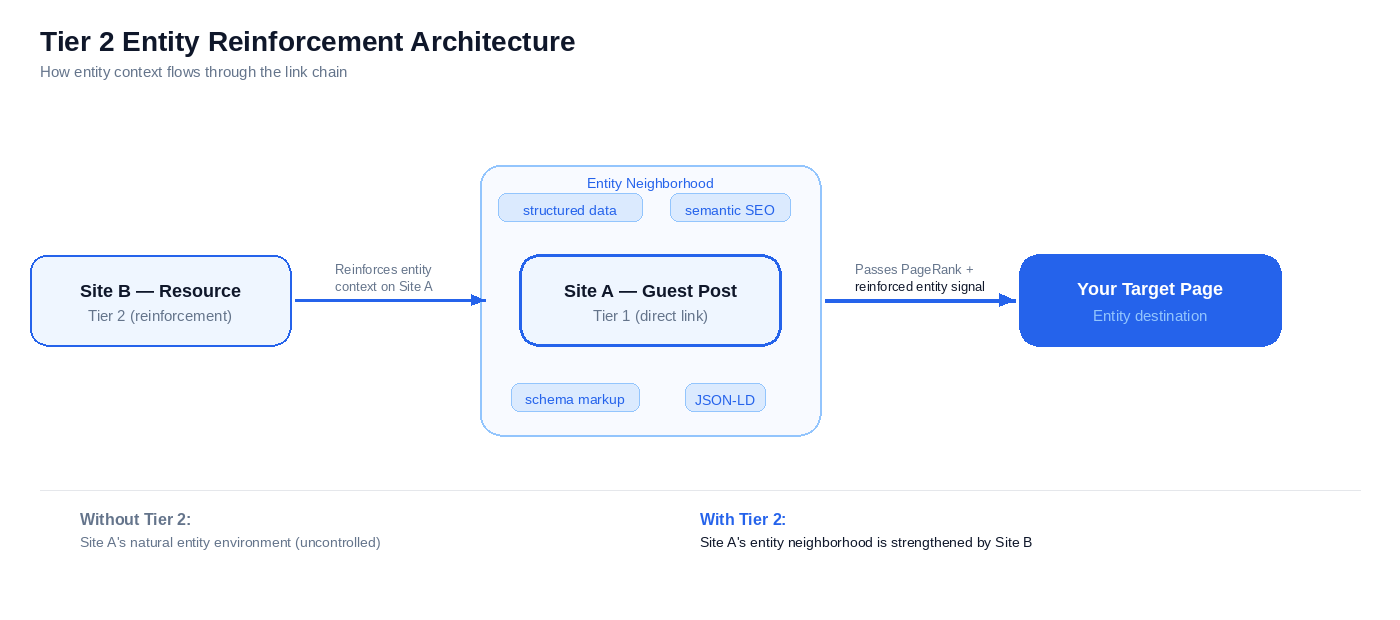
Without Tier 2 reinforcement, your Tier 1 link sits in whatever entity environment Site A’s page naturally has. With it, you’ve strengthened the entity relevance of the page that links to you, which strengthens the entity signal the link carries.
To identify Tier 2 targets, run the NLP API against pages that already link to your Tier 1 sources. Pages where your target entities score low or don’t appear are the ones that benefit most from Tier 2 reinforcement – earning an entity-relevant link to that page strengthens the entity neighborhood your Tier 1 link sits in.
Tier 2 building isn’t link manipulation. You’re earning contextual reinforcement for pages that already reference your entities – promoting genuinely useful resources to sites that would benefit from citing them. The distinction is intent and relevance. If the Tier 2 link wouldn’t make sense to a reader of that page regardless of your link building goals, don’t pursue it.
Validation – How to Confirm Entity Links Work
Link building without validation is guesswork. Entity-based link building gives you something most link campaigns don’t: a measurable before-and-after. Use it.
Before/after entity salience comparison. Run your target page through the NLP API before you start outreach. Record the salience scores for every entity Google extracts. Run it again 6–8 weeks after your links go live. Compare. If your target entities increased in salience – or if new entity associations appeared that match the entities on your linking pages – the campaign moved the graph. If the scores are flat, the links didn’t carry enough entity signal to register. The prospecting criteria need tightening.
Knowledge Graph Search API check. Query the Knowledge Graph Search API for your brand or author entity. Track whether the entity is recognized and what properties Google associates with it. If your entity doesn’t appear in results, it hasn’t reached Knowledge Graph status yet. If it does appear, check the description and detailedDescription fields – they reveal which topic associations Google considers strongest.
import requests

def check_kg_entity(query, api_key):
    """Check if an entity appears in Google's Knowledge Graph."""
    endpoint = "https://kgsearch.googleapis.com/v1/entities:search"
    params = {
        "query": query,
        "key": api_key,
        "limit": 5,
        "indent": True
    }

    try:
        response = requests.get(endpoint, params=params, timeout=10)
        response.raise_for_status()
    except requests.exceptions.HTTPError as e:
        # 403 is the most common error - usually an invalid or restricted API key
        print(f"API error {response.status_code}: check your API key in Google Cloud Console")
        return
    except requests.exceptions.RequestException as e:
        print(f"Request failed: {e}")
        return

    results = response.json().get("itemListElement", [])

    if not results:
        print(f"No Knowledge Graph results for '{query}'")
        return

    for item in results:
        entity = item.get("result", {})
        print(f"Name: {entity.get('name')}")
        print(f"Type: {entity.get('@type')}")
        print(f"Description: {entity.get('description', 'None')}")
        print(f"Score: {item.get('resultScore', 0)}")
        print("---")

check_kg_entity("Your Brand Name", "YOUR_API_KEY")
Run this monthly. The resultScore value indicates how confidently Google matches your query to a known entity. Track it over time.
Search Console entity query monitoring. Track impressions in Google Search Console for queries that combine your brand or author name with your target topic terms – “your brand + structured data,” “your name + semantic SEO.” Rising impressions for these compound queries mean Google is strengthening the association between your entity and those topics. Clicks matter less here than impression trends. The query appearing at all confirms the entity-relationship exists in Google’s index.
Timeline expectations. Entity signals don’t move on PageRank timelines. PageRank transfers as soon as Google crawls and indexes the linking page. Entity graph updates depend on reconciliation cycles that operate on a separate schedule. Set a minimum 6–8 week measurement window before evaluating results. Checking at two weeks tells you nothing about entity signal – only whether the links were indexed.
Common Mistakes
Conflating topical relevance with entity relevance. A page about “SEO tips” is topically adjacent to your structured data content. That doesn’t mean it carries entity signal. Run the NLP API. If your target entities don’t appear above 0.1 salience, the link is topically relevant and entity-irrelevant. These are different things.
Ignoring author attribution on guest posts. You negotiated the placement, wrote the content, earned the link – and published it without a byline. The link passes PageRank. It doesn’t feed author entity reconciliation. Every anonymous guest post is entity signal left on the table. Insist on named attribution and, where possible, Person schema.
Chasing DA on entity-irrelevant domains. A DA 80 link from a general news site that mentions your brand in a roundup alongside forty others? Low entity salience, minimal corroboration value. A DA 30 link from a focused technical blog where your target entity scores 0.3 salience? That’s the one moving your entity graph. Domain Authority measures the site. Salience measures the signal.
Skipping validation entirely. If you don’t measure entity salience before and after a campaign, you can’t distinguish entity link building from regular link building. Without before-and-after salience data, you’re doing the same outreach with extra steps and no way to prove the entity layer worked.
Expecting results in two weeks. PageRank transfers on crawl. Entity graph updates operate on a different cycle entirely. Two weeks of flat Search Console data doesn’t mean the campaign failed – it means the reconciliation cycle hasn’t completed. The 6–8 week window isn’t conservative. It’s the minimum for a meaningful read.
Frequently Asked Questions
What is entity-based link building?
Entity-based link building is the practice of acquiring backlinks and co-occurrences that strengthen a specific entity’s position in Google’s Knowledge Graph. Instead of optimizing for domain authority metrics, you focus on building links from pages where your target entities appear with high salience – measured through entity salience scoring with tools like the Google Natural Language API.
How does semantic SEO affect link building?
Semantic SEO shifts link evaluation from anchor text and PageRank to entity relationships. Google extracts entities from both the linking page and the target page, then evaluates the overlap. Links between pages with strong entity relevance carry stronger signals than links between topically unrelated domains, regardless of DA scores. The semantic co-occurrence signals on the linking page determine how much entity value the link transfers.
Are backlinks still important in 2026?
Backlinks remain a core ranking signal. What’s changed is how Google evaluates them. The entity context of the linking page – which entities appear and how salient they are – now matters as much as the link’s authority metrics. A high-salience entity match on a lower-authority page can outperform a generic mention on a high-authority domain.
How do you build an entity in SEO?
You build an entity through consistent signals across multiple sources: structured data (Person or Organization schema with Wikidata sameAs), consistent author attribution on third-party content, and co-occurrences with topic entities on authoritative pages. Entity-based link building is one primary method for strengthening these signals. Knowledge Graph corroboration – the compounding effect of multiple independent sources confirming the same entity-relationship – is what makes it work over time.
Where This Fits
Entity-based link building is one component of a broader semantic SEO strategy. For the entity measurement pipeline behind the validation workflow, see how Google’s NLP processes content. For connecting author signals to Google’s expertise evaluation, see E-E-A-T and entity SEO.