
Effective Google NLP SEO starts with a technical reality: Google’s natural language processing stack doesn’t “understand meaning” as a single operation. It runs your text through a sequence of processing stages – tokenization, parsing, entity extraction, resolution, salience scoring – and each stage is a point where your content either registers semantically or doesn’t.
Most guides skip the pipeline and jump to optimization tips. This one maps the mechanism: every stage, what it extracts, and how to validate your content against Google’s own NLP model. For the strategic framework behind why this matters for ranking, see our complete semantic SEO guide.
What Happens Between Crawl and Semantic Index?
Between Googlebot fetching your page and Google indexing it by concept, your text passes through a processing pipeline. Each stage extracts a different layer of signal. Each stage can also lose signal if your content is ambiguous, unresolvable, or unfocused. Google’s own documentation on how Search works describes the crawl-render-index sequence. What it doesn’t detail is the NLP processing that happens between rendering and indexing.
The full sequence looks like this:
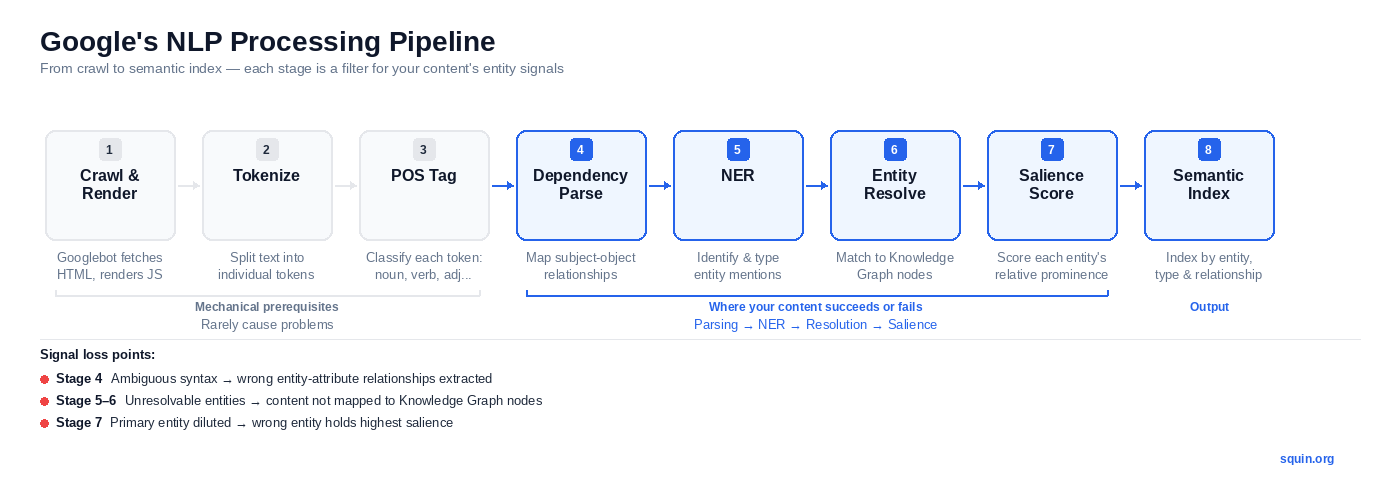
1. Crawl and render. Googlebot fetches your HTML. If the page uses client-side JavaScript, Google’s Web Rendering Service executes it and produces a fully rendered DOM. Everything downstream operates on the rendered output – not your source HTML.
2. Tokenization. The rendered text gets split into individual tokens – words, punctuation, numbers. This is mechanical. Your content doesn’t fail here unless it’s not text at all (images without alt text, content locked inside canvas elements).
3. Part-of-speech tagging. Each token gets classified: noun, verb, adjective, preposition. POS tagging is the foundation for everything that follows. Google needs to know that “Apple” is functioning as a proper noun in your sentence before it can attempt entity resolution. Mechanical, but necessary.
4. Dependency parsing. Google maps the grammatical relationships between tokens. Which word is the subject. Which is the object. Which modifies which. This is the stage where sentence structure starts to matter for SEO – ambiguous syntax means ambiguous entity-attribute relationships.
5. Named-entity recognition (NER). Google’s models identify entity mentions in your text and classify them by type: PERSON, ORGANIZATION, LOCATION, EVENT, CONSUMER_GOOD, WORK_OF_ART, and OTHER – among other types documented in the API reference. A string becomes a typed entity candidate.
6. Entity resolution. Each NER candidate gets matched against Google’s Knowledge Graph. “Apple” resolves to Apple Inc. (Q312) or stays unresolved. This is where your co-occurring entities, schema markup, and links to knowledge bases either help Google disambiguate or leave it guessing.
7. Salience scoring. Google assigns each resolved entity a salience score – how central that entity is to your page’s content. Scores are relative – each entity’s salience reflects its prominence compared to every other entity on the page. Your primary topic should hold the highest score.
8. Semantic indexing. The page gets indexed not just by keywords but by the entities it covers, their types, their relationships, and their prominence. This is what allows Google to rank your page for queries you never explicitly targeted – because it understands the concept, not just the string.
Every stage is a filter. Content that’s syntactically ambiguous loses signal at stage 4. Content with unresolvable entities loses signal at stage 6. Content where the primary topic competes with dozens of secondary mentions loses signal at stage 7.
Stages 1 through 3 are prerequisites – they rarely cause problems for well-structured pages. The stages that determine whether your content registers semantically are 4 through 7: dependency parsing, NER, entity resolution, and salience scoring. Each gets its own section below, starting with the model that changed how stages 4 and 5 work entirely.
How Does BERT’s Attention Mechanism Change What Google Extracts?
BERT is the model that made BERT for SEO a real discipline rather than a buzzword. Before BERT, Google’s primary machine learning system for search was RankBrain – launched in 2015 to handle ambiguous and novel queries. But RankBrain and the language models available at the time processed text in one direction – left to right. That meant prepositions, negation, and qualifier words got underweighted. The model hadn’t seen what came after them yet, so it couldn’t fully interpret what they meant.
BERT processes in both directions simultaneously. Every word gets interpreted in the context of every other word in the sentence – left-to-right and right-to-left at the same time. That’s what “bidirectional” means in practice, and it’s what changed how Google handles language at the query and passage level.
The NLP attention mechanism is the specific architecture that makes this work. BERT uses multiple attention heads – parallel processors that each learn to focus on different types of relationships within a sentence. One head might track subject-verb agreement. Another might track which entity a preposition connects to. Another might track negation scope. Each head assigns a weight to every word pair in the sentence, determining how much one word should influence the interpretation of another.
That’s why the query “2019 brazil traveler to usa need a visa” stopped returning results about Americans traveling to Brazil after BERT launched. The attention mechanism correctly weighted the preposition “to” in context with the surrounding entities. Before BERT, “to” was nearly invisible to the model. After BERT, it became the word that determined the entire query’s meaning.
Google’s BERT announcement in 2019 stated that BERT affected approximately one in ten English-language searches in the US at launch. At the Search On 2020 event in October of that year, Google announced that BERT had expanded to power almost every English-language query.
Two practical consequences for your content:
Sentence structure matters more than keyword placement. If Google’s parser can’t determine which entity is the subject and which is the object in your sentence, the attention mechanism can’t properly weight the relationship between them. A sentence like “The product review site analyzed Apple’s latest pricing strategy” gives BERT clear subject-object-attribute structure. A sentence like “Pricing strategy analysis from the latest Apple product review site” forces the model to untangle stacked noun phrases with no clear grammatical hierarchy. Same keywords. Different parseability.
BERT operates at the passage level, not the page level. A single well-structured paragraph where your target entity is the clear subject, defined with specific attributes and placed in explicit relationship to other entities, can register high salience even within a longer page that covers multiple sub-topics. This aligns with passage-level ranking – Google’s ability to extract and rank a specific section of your page independently from the rest.
BERT changed what Google extracts from individual sentences and passages. The next model in the stack – MUM – changed what Google can assess across content types and languages.
What Does MUM Add Beyond BERT? (Multitask Unified Model)
BERT processes text. MUM processes text, images, and video – across 75 languages simultaneously. Google announced the Multitask Unified Model in 2021 as a step beyond single-task, single-language understanding.
Three capabilities separate MUM from BERT:
Multimodal. MUM processes text, images, and video within a single model. In practice, this cross-modal capability currently applies to Google Lens and Multisearch – not standard web SERPs. A photo of hiking boots can inform a query about trail recommendations within those visual search features, but Google hasn’t confirmed cross-modal processing for standard organic ranking.
Multilingual. A medical concept thoroughly documented in German research papers can inform Google’s understanding of an English-language query about the same topic. MUM transfers knowledge across 75 languages, which means information that exists only in non-English sources can still shape how Google evaluates topical completeness for English queries.
Multitask. Where BERT handles one NLP task at a time (entity extraction, sentiment, syntax), MUM handles multiple tasks in a single pass – understanding the query, assessing the content, and evaluating completeness together.
What Google has confirmed: MUM powers specific features. COVID-19 vaccine name matching across languages, where brand names and common names differed by region. The “things to know” refinements in search results. “Broaden this search” and “Refine this search” suggestions. Visual search improvements in Google Lens.
What Google hasn’t confirmed: whether MUM processes every indexed page the way BERT does. BERT’s deployment to the core ranking pipeline is well-documented. MUM’s deployment appears more selective – applied to specific features rather than as a universal ranking layer.
The practical implication for most practitioners is narrower than the hype suggests. MUM means Google can assess topical completeness across content types and languages. A competitor’s coverage of your topic in a Japanese video could inform how Google evaluates your English article. But for the majority of sites, topical completeness within your primary language and content type still drives the most measurable impact. Don’t optimize for MUM specifically. Optimize for comprehensive entity coverage – the same signals that feed BERT also feed MUM where it’s deployed.
MUM and BERT determine how Google interprets your content at the model level. The next question is more immediate: what happens when those models extract specific entities from your text, and how do you validate what they find?
How Does Google Extract and Score Entities in Your Text?
The previous sections covered how Google parses language structure. This section covers what Google does with that structure – extracting entities, scoring their importance, and assessing how you discuss them. These are the NLP stages you can directly validate using Google’s own API.
Named-Entity Recognition – From Strings to Knowledge Graph Nodes
Named-entity recognition is the stage where text strings become typed entities. Google’s NLP models scan your content, identify mentions that refer to real-world things, and classify each one by type: PERSON, ORGANIZATION, LOCATION, EVENT, CONSUMER_GOOD, WORK_OF_ART, and OTHER – among other types including ADDRESS, DATE, NUMBER, and PRICE. NER is the technical mechanism behind what practitioners call entity SEO – the practice of making your entities identifiable and unambiguous to Google’s systems.
Two outcomes are possible for each entity NER identifies.
A resolved entity has a MID (Machine Identifier) and a Wikipedia URL in the API output. MIDs use two prefix conventions: /m/ for Freebase-era identifiers that Google inherited, and /g/ for newer Google-native identifiers. Both function the same way in the Knowledge Graph. When the API returns a MID, it means Google matched the text string to a known node in its Knowledge Graph. The entity “BERT” in your content resolves to /g/11bx2nrdx9 with a Wikipedia link to the BERT language model page. Google knows exactly what thing you’re writing about.
An unresolved entity is one Google recognizes as a thing – it assigns a type and a salience score – but can’t match to a Knowledge Graph entry. No MID. No Wikipedia URL. The entity exists in your content but not in Google’s structured understanding of the world. Unresolved entities are expected for obscure or novel concepts. It is a problem if your primary topic entity doesn’t resolve, because it means Google can’t connect your page to a known node.
When the NLP API returns a MID, you can take that identifier and plug it directly into the [Knowledge Graph Search API] (coming soon) to see the full entity record Google stores – including the Result Score, which reflects Google’s confidence in that entity’s identity and prominence within the graph. The call takes the MID as a parameter:
curl "https://kgsearch.googleapis.com/v1/entities:search?ids=/g/11bx2nrdx9&key=YOUR_API_KEY&limit=1"
The response includes the entity’s name, description, types, and a resultScore reflecting how well-established it is in Google’s graph. A high Result Score means the entity is well-established. A low score means it barely registers. That cross-referencing workflow – NLP API to Knowledge Graph API – is a validation step worth running on every primary entity you target.
Co-occurring entities are what help NER disambiguate. “Mercury” alone is ambiguous. “Mercury” alongside “orbit,” “atmosphere,” and “NASA” resolves to the planet. “Mercury” alongside “Freddie,” “Bohemian Rhapsody,” and “Queen” resolves to the band. The more entity context you provide in the surrounding text, the more confidently NER resolves the right node. For a full breakdown of how disambiguation works and what you can do when it fails, see our guide to entity disambiguation.
What Entity Salience and Sentiment Actually Measure
NER tells Google which entities are on your page. Salience tells Google which ones matter most. These are different questions with different scoring mechanisms, and most guides conflate them.
Salience runs from 0 to 1. Scores across all entities on a page are relative – they approximate a total of 1.0, meaning entities compete for share. If your page mentions 30 entities, each one pulls from the same pool. Your primary topic entity should hold the highest salience score. If a tool name you mentioned once, a brand you used as an example, or a competitor you cited in passing scores higher than your core topic – your content is giving more prominence to the wrong entity.
What drives salience isn’t repetition. Repeating “Knowledge Graph” fifteen times doesn’t increase its salience score. Defining it, explaining its attributes, describing how it relates to other entities on the page – that moves the score. Salience rewards contextual depth. Salience validation confirms whether your coverage of semantic keywords actually registers at the entity level, or just occupies surface area.
Resolution metadata is the second signal most guides ignore entirely. When the API returns an entity with a MID and a Wikipedia URL in the metadata field, Google has resolved that entity to a known Knowledge Graph node. When metadata is empty – no MID, no Wikipedia URL – Google identified something in your text but couldn’t match it to a known entity. The mention type field adds granularity: PROPER means Google recognized a specific named entity, COMMON means it found a generic reference, and TYPE_UNKNOWN means it couldn’t classify the mention at all.
The diagnostic framework:
- Low salience with full metadata (MID and Wikipedia URL present): Google confidently identified the entity but considers it a minor mention on your page. Expected for secondary entities.
- High salience with empty metadata: the entity is prominent in your content but Google can’t resolve it to a known node. That’s a disambiguation problem – your co-occurring entities aren’t providing enough context, or the entity doesn’t yet have a Knowledge Graph entry.
- Full metadata on a secondary entity but empty metadata on your primary topic is the most actionable finding in the entire API output. It means Google can identify everything around your core subject but can’t resolve the subject itself.
Entity sentiment adds a third dimension. The Google Cloud Natural Language API returns entity-level sentiment alongside salience – a score from -1.0 (negative) to 1.0 (positive) plus a magnitude value indicating strength of the sentiment signal. A brand entity with high salience but negative sentiment tells a different story than the same entity with positive sentiment. For practitioners auditing comparison pages, brand content, or product reviews, entity sentiment reveals whether your coverage frames each entity favorably, neutrally, or negatively. That framing is a signal Google’s models can read – and it may influence how Google associates your page with that entity’s Knowledge Graph node.
The API requires a Google Cloud project with the Natural Language API enabled and an API key. The free tier covers 5,000 entity analysis requests per month – enough for iterative testing on most sites. Send your main content body only, excluding navigation, headers, footers, and sidebar text. Boilerplate dilutes salience scores, and the API charges per 1,000 characters analyzed.
The API call that returns salience, resolution metadata, and sentiment in a single response:
curl -X POST \
"https://language.googleapis.com/v1/documents:analyzeEntitySentiment?key=YOUR_API_KEY" \
-H "Content-Type: application/json" \
-d '{
  "document": {
    "type": "PLAIN_TEXT",
    "content": "Google uses BERT to process search queries at the passage level. BERT applies bidirectional attention heads to weigh word relationships in context. Before BERT, Google relied on RankBrain for query interpretation, but RankBrain could not handle prepositions or negation with the same precision."
  },
  "encodingType": "UTF8"
}'
The response (truncated to the top two entities) looks like this:
{
  "entities": [
    {
      "name": "BERT",
      "type": "OTHER",
      "metadata": {
        "mid": "/g/11bx2nrdx9",
        "wikipedia_url": "https://en.wikipedia.org/wiki/BERT_(language_model)"
      },
      "salience": 0.5985,
      "mentions": [
        { "text": { "content": "BERT", "beginOffset": 12 }, "type": "PROPER", "sentiment": { "magnitude": 0.0, "score": 0.0 } },
        { "text": { "content": "BERT", "beginOffset": 65 }, "type": "PROPER", "sentiment": { "magnitude": 0.0, "score": 0.0 } },
        { "text": { "content": "BERT", "beginOffset": 161 }, "type": "PROPER", "sentiment": { "magnitude": 0.0, "score": 0.0 } }
      ],
      "sentiment": { "magnitude": 0.0, "score": 0.0 }
    },
    {
      "name": "Google",
      "type": "ORGANIZATION",
      "metadata": {
        "mid": "/m/045c7b",
        "wikipedia_url": "https://en.wikipedia.org/wiki/Google"
      },
      "salience": 0.2106,
      "mentions": [
        { "text": { "content": "Google", "beginOffset": 0 }, "type": "PROPER", "sentiment": { "magnitude": 0.0, "score": 0.0 } },
        { "text": { "content": "Google", "beginOffset": 141 }, "type": "PROPER", "sentiment": { "magnitude": 0.0, "score": 0.0 } }
      ],
      "sentiment": { "magnitude": 0.0, "score": 0.0 }
    }
  ],
  "language": "en"
}
A note on the response: beginOffset values are byte offsets, not character positions. With UTF-8 encoding (set by the encodingType parameter), these match character positions for ASCII text but diverge for multi-byte characters like accented letters or CJK scripts. The response above is simplified for clarity – actual output includes additional fields per entity and per mention.
Three things to read in this output:
BERT holds the highest salience (0.5985). It’s the primary entity of this passage. Google holds 0.2106. RankBrain (not shown in this truncation) takes the remainder. If this were a page about Google as a company, that salience distribution would tell you the passage needs restructuring – the subject of your page is being overshadowed.
Both entities resolved. MIDs and Wikipedia URLs are present in the metadata field. Google matched “BERT” to the language model and “Google” to the corporation. No disambiguation failure. If one of these had returned with empty metadata – no MID, no Wikipedia URL – you’d know Google couldn’t resolve that entity, and you’d need to add co-occurring context or schema about properties to help.
Sentiment is neutral (0.0) across all mentions. For a technical passage, that’s expected. On a comparison page where you describe a competitor product, you’d expect to see sentiment divergence between entities – and that divergence tells you how Google characterizes your framing.
The validation loop: write or revise your content, run the analyzeEntitySentiment endpoint, check whether your primary entity holds the highest salience, verify that primary entities have MIDs in the metadata field, review sentiment on brand or product entities, then revise and re-run. For the full API implementation workflow including competitor benchmarking, see our Google NLP API for SEO guide.
Salience, resolution metadata, and sentiment tell you what Google extracts and how it scores what it finds. But those scores depend on something more fundamental – whether Google’s parser can correctly determine which entity is the subject, which is the object, and what the relationship between them is. That’s the job of dependency parsing.
What Role Do Dependency Parsing and Syntax Analysis Play?
Dependency parsing in SEO is the least discussed NLP stage – and the one that determines whether Google attributes the right properties to the right entities in your content.
Dependency parsing maps the grammatical relationships between words in a sentence. Subject. Object. Modifier. Instrument. Google’s NLP models use these relationships to determine which entity gets credited with which attribute or action.
Two sentences with identical entities. Different parses:
“Google uses BERT to process search queries.” Dependency parse: Google = agent (nsubj), BERT = instrument (dobj of “uses”), queries = object of the processing. Google is the actor. BERT is the tool.
“BERT processes search queries for Google.” Dependency parse: BERT = agent (nsubj), queries = direct object, Google = beneficiary (prep modifier). BERT is the actor. Google is the context.
You can validate this using the Cloud NLP API’s analyzeSyntax endpoint. Run the first sentence through it:
curl -X POST \
"https://language.googleapis.com/v1/documents:analyzeSyntax?key=YOUR_API_KEY" \
-H "Content-Type: application/json" \
-d '{
  "document": {
    "type": "PLAIN_TEXT",
    "content": "Google uses BERT to process search queries."
  },
  "encodingType": "UTF8"
}'
The response returns each token with its dependencyEdge label (truncated to the three key tokens):
{
  "tokens": [
    {
      "text": { "content": "Google" },
      "partOfSpeech": { "tag": "NOUN" },
      "dependencyEdge": { "headTokenIndex": 1, "label": "NSUBJ" }
    },
    {
      "text": { "content": "uses" },
      "partOfSpeech": { "tag": "VERB" },
      "dependencyEdge": { "headTokenIndex": 1, "label": "ROOT" }
    },
    {
      "text": { "content": "BERT" },
      "partOfSpeech": { "tag": "NOUN" },
      "dependencyEdge": { "headTokenIndex": 1, "label": "DOBJ" }
    }
  ]
}
NSUBJ marks Google as the nominal subject. DOBJ marks BERT as the direct object. ROOT is the main verb. Change the sentence to “BERT processes search queries for Google” and NSUBJ shifts to BERT – the parser attributes agency differently.
Same keywords. Same entities. Different entity-attribute relationships extracted. If your page is about Google’s search technology, the first sentence reinforces Google as the primary entity. The second shifts agency to BERT – which may or may not match your intent.
This matters when your sentences are less clear than these examples. Stacked prepositional phrases, dangling modifiers, and unclear pronoun references create genuine ambiguity for the parser. “The analysis of the product review site’s pricing strategy for enterprise customers” forces Google to untangle multiple nested relationships with no clear subject. Who analyzed what? Which entity owns the pricing strategy? The parser has to guess.
The fix isn’t “write simply.” It’s write with unambiguous entity-relationship structure. Make the subject of each sentence the entity you want Google to associate with the action or attribute. Keep the distance between subject and verb short. When a sentence involves multiple entities, make the grammatical hierarchy explicit rather than stacking nouns.
Dependency parsing is where Google’s NLP transitions from mechanical processing to something closer to understanding. That transition has a name – and the distinction between processing and understanding matters more than most practitioners realize.
NLP vs. NLU – Does the Distinction Matter for SEO?
Yes. Because most practitioners optimize for the wrong layer.
Natural Language Understanding (NLU) vs NLP is a distinction the SEO industry almost never makes. It should. NLP – Natural Language Processing – is the broad field. It covers every computational operation on human language: tokenization, POS tagging, syntax parsing, text generation. The mechanical stages from the pipeline earlier in this article are NLP tasks.
Natural Language Understanding is the subset that extracts meaning. Intent classification. Entity resolution. Relationship mapping. Salience scoring. Sentiment analysis. NLU is where Google moves from parsing your text to knowing what it’s about.
Google’s search stack runs both. The NLP stages prepare your text – they break it into tokens, tag parts of speech, map dependencies. The NLU stages interpret it – they resolve entities against the Knowledge Graph, score salience, match intent.
The practical consequence: when someone says “optimize for NLP,” they almost always mean “optimize for NLU.” Your content doesn’t fail at tokenization. Google can tokenize anything. It doesn’t fail at POS tagging either. Your content fails – when it fails – at entity resolution, salience scoring, and intent matching. Those are NLU problems. Knowing which layer actually causes your content to underperform changes where you invest effort. If your primary entity isn’t resolving, that’s an NLU problem you fix with co-occurring entities and schema declarations. If your primary entity resolves but holds low salience, that’s a different NLU problem you fix with contextual depth.
The distinction is conceptual, not a separate workflow. But precision about what you’re optimizing for prevents you from solving the wrong problem. And solving the wrong problem is where most NLP-for-SEO efforts break down – which brings us to the full list of common mistakes.
Common Mistakes in Google NLP SEO
Six errors that show up repeatedly in semantic SEO audits. Each one is specific enough to check on your own content today.
1. Treating NLP optimization as keyword density with better vocabulary. Swapping “semantic SEO” for “entity-based search optimization” doesn’t improve entity salience. Google’s NLP models don’t reward synonym variation. They reward contextual depth – defining an entity’s attributes, explaining its relationships to other entities, describing what it does and why it matters. If your entity coverage is shallow, dressing it in different words changes nothing.
2. Running the NLP API once and never again. Salience is relative. It shifts every time you edit content. Adding a 500-word section about a secondary topic can push your primary entity’s salience score down because you’ve introduced competing entities into the same pool. The Cloud NLP API is a revision loop, not a one-time check. Run it after every significant content update.
3. Assuming BERT means long-form always wins. BERT operates at the passage level. Google can extract and rank a single well-structured paragraph independently from the rest of your page. A focused 800-word article where every passage reinforces the primary entity with high salience can outperform a 3,000-word piece where the target entity gets diluted across dozens of secondary topics and tangential examples. Length without entity focus is noise.
4. Writing for a content optimization score instead of entity clarity. Surfer and Clearscope measure term coverage against a model built from the current SERP. Google’s NLP measures entity salience, resolution status, and relationship clarity. These are related but not identical targets. A Surfer score of 90 tells you your term distribution matches the competition. It doesn’t tell you whether your primary entity holds the highest salience on the page. Both signals are useful. Don’t confuse one for the other.
5. Ignoring resolution metadata on primary entities. High salience with empty metadata – no MID, no Wikipedia URL – means Google sees your primary entity as prominent but can’t resolve it to a Knowledge Graph node. That’s not a depth problem. It’s a disambiguation problem – and the fix is different. You add co-occurring entities and schema about properties with Wikidata URIs, not more paragraphs about the same topic. Always check whether your primary entity returned a MID.
6. Ignoring sentence-level entity relationships. You’ve covered the right entities. Your salience scores look correct. But Google’s dependency parser is attributing properties to the wrong entity because your sentence structure is ambiguous. A stacked noun phrase like “Google’s BERT-based query processing system” forces the parser to determine whether “query processing” belongs to Google, to BERT, or to the system. These parsing errors are invisible in any tool that only checks term frequency. You find them by reading your own sentences and asking: is the subject-object-attribute relationship unambiguous?
Pro Note: The Cloud NLP API is a commercial product built on Google’s NLP infrastructure. It’s the closest publicly available approximation of how Google’s models parse text. But it’s not the exact model running inside Search. Salience scores, resolution metadata, and entity sentiment from the API are directional – they tell you whether your content is moving in the right direction, not whether Google Search will produce identical outputs. Use the API as a strong proxy. Don’t treat it as ground truth.
Frequently Asked Questions
What is NLP in SEO?
NLP in SEO refers to how Google’s natural language processing models extract meaning from your content – identifying entities, parsing relationships, and scoring salience – to index your pages by concept rather than just by keyword. It’s the technical layer that makes semantic SEO work.
Does Google use NLP?
Google uses multiple NLP models in its search stack. BERT handles bidirectional language understanding at the word and passage level. MUM adds multilingual and multimodal capability. Gemini powers AI Overviews by synthesizing information across sources. These models work together to parse queries and page content into entities and relationships.
How does Google’s NLP affect rankings?
Google’s NLP models determine what your content is about at the entity level – not just which keywords it contains. Pages where the NLP pipeline can clearly extract, resolve, and score entities rank for broader topic queries because Google understands the concept, not just the string. NLP is an understanding mechanism, not a direct ranking factor.
What is entity salience in Google’s NLP?
Entity salience is a score from 0 to 1 that measures how prominent an entity is in your content. Scores across all entities on a page are relative – entities compete for share. Your primary topic should hold the highest salience. You can test this using Google’s Cloud Natural Language API.
What’s the difference between NLP and NLU in SEO?
NLP (Natural Language Processing) is the broad field covering all computational language tasks – tokenization, parsing, generation. NLU (Natural Language Understanding) is the subset focused on meaning extraction – intent, entity resolution, relationships. When SEOs say “optimize for NLP,” they typically mean optimize for the NLU layer – the part that determines what your content means.
Where This Fits
This article is part of our semantic SEO series covering how Google processes, understands, and ranks content at the entity level. It covers the mechanism – how Google’s NLP stack processes your content into entities, salience scores, and sentiment signals. The strategic framework for using these signals sits in the semantic SEO guide.
Next steps: entity disambiguation for understanding how Google resolves ambiguous entities, and the Google NLP API for SEO guide for the full validation workflow with competitor benchmarking.