
Surfer SEO and Clearscope they don’t do the same thing. They look similar – both give you a content editor, both score your writing, both claim to use NLP.
But they run different engines, model relevance differently, and produce scores that aren’t interchangeable. Most comparisons skip this and jump to pricing tables.
Here you’ll get the architectural difference between their NLP pipelines, where each tool fits in a semantic SEO tools workflow, and what actually changes when you scale from 10 reports a month to 100.
What Actually Differs Between Surfer SEO and Clearscope?
The difference isn’t features. It’s what each tool measures and how it decides what “optimized content” means.
How Each Tool Models Content Relevance
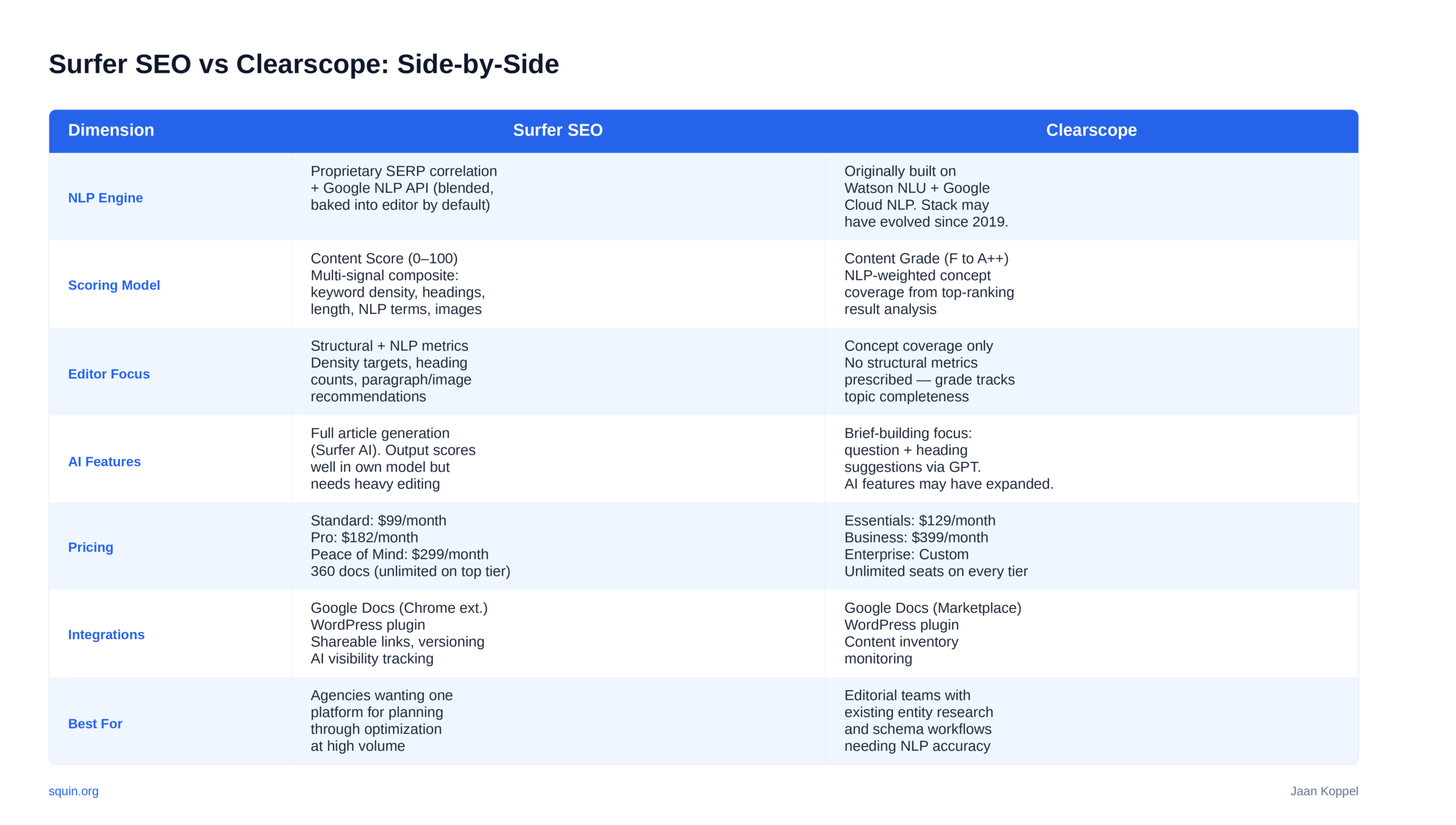
Clearscope was originally built entirely on IBM Watson Natural Language Understanding – and IBM even published a 2019 case study confirming that architecture. But as AI models evolved, Clearscope migrated to a multi-model stack. Today, its engine runs on a combination of OpenAI, Google Cloud NLP, and IBM Watson.
That’s the Clearscope IBM Watson NLP foundation as it was documented. The core question it asks hasn’t changed regardless of the underlying engine: what concepts does natural language processing consider important for this topic?
Surfer SEO takes a different approach entirely. The Surfer SEO NLP algorithm reverse-engineers pages that already rank. You choose how many top results to analyze – the top 3, 5, 10, or 20 – and Surfer scans what it describes as 500+ on-page signals across that set. Keyword usage, heading structure, content length, paragraph count, image frequency, NLP terms. It builds a composite model of what ranking pages have in common and scores your content against that model. Surfer previously required users to manually toggle a Google NLP API integration to get entity data, but that architecture has evolved. Today, Surfer uses a blended engine combining Google’s NLP API with its own proprietary machine learning-baked directly into the editor’s recommendations by default.
Clearscope models what NLP considers salient about a topic. Surfer models what currently ranks for a query. These aren’t the same thing – a concept can be highly salient to a topic without appearing on a single page-one result, and a term can appear across every ranking page without carrying semantic weight in isolation.
Both approaches connect to how Google’s NLP processes content, but they model it from opposite directions.
What the Content Scores Actually Measure
Clearscope grades your content from F to A++ based on concept coverage. Its scoring weights topic completeness as determined by NLP extraction of the top-ranking results. Salience – the score each concept receives from 0.0 to 1.0 based on how central it is to the analyzed content – drives the weighting. Write about the concepts the NLP engine considers salient, and your grade climbs. Miss them, and it drops. Structural factors like word count and heading count don’t drive the grade the way they do in Surfer.
Surfer’s Content Score runs from 0 to 100 and measures alignment across multiple signal categories: keyword density, NLP terms, heading count, paragraph structure, content length, and image usage. It’s a composite score. You can satisfy the NLP terms completely and still score low if your heading structure or word count falls outside the range Surfer derived from ranking pages.
That’s the core of any content grading algorithm comparison between these tools. The same article can score 92 in Surfer and B+ in Clearscope – or 67 in Surfer and A in Clearscope. They aren’t measuring the same dimension of content quality.
Neither score is wrong. They answer different questions. Clearscope asks: does this content cover what NLP considers topically essential? Surfer asks: does this content structurally match what Google currently ranks? Practitioners who chase high scores in both tools simultaneously are optimizing for two models that sometimes pull in opposite directions.
That architectural gap affects every practical decision downstream – starting with how each editor handles the writing process and what their AI features actually produce.
How Do the Content Editors and AI Features Compare?
Both tools give you a content editor. The experience of using them affects your daily workflow.
Editor Workflow and Integrations
Surfer’s editor tracks everything. As you write, terms turn green when you hit suggested density targets. The sidebar shows recommended heading count, paragraph count, word count range, and image count – all derived from the SERP analysis you configured. That density-target approach encourages thoroughness, but it also nudges writers toward including marginal terms just to turn indicators green. You write directly in Surfer’s editor or connect it to Google Docs through a Chrome extension. A WordPress plugin handles in-CMS optimization. For teams, shareable editor links support versioning and inline comments.
Clearscope’s editor focuses on concept coverage – the terms its NLP engine considers salient – without prescribing structural metrics like heading counts or image targets. Your content grade updates as you write. The interface is simpler, but that simplicity means you need a separate content brief for heading structure and formatting guidance. Google Docs integration runs through a Marketplace add-on. WordPress gets a plugin. Higher-tier plans include unlimited user seats, which matters for large editorial teams more than the per-credit model Surfer uses.
Both tools have native editors that practitioners use daily. The difference isn’t that one is an editor and the other is an overlay – it’s that Surfer’s editor prescribes structural metrics alongside NLP terms while Clearscope’s focuses on concept coverage alone.
AI Content Generation Quality
Surfer AI generates full articles from a target keyword. The output typically scores well in Surfer’s own Content Score. Not surprising – it’s optimizing against its own model. Clearscope has since expanded its feature set to include an ‘AI Draft’ tool, but its approach remains much more constrained. Rather than one-click full-article generation, Clearscope forces a guided workflow: you must select the search intent and manually approve the AI-generated outline before it drafts the text. It functions more as an accelerated brief-builder than an autonomous writer.
When comparing Surfer AI vs Clearscope on output quality, the question isn’t which scores higher. It’s whether high-scoring AI content actually covers the topic or just pattern-matches the scoring model. In practice, both tools produce AI output that needs heavy editing before it carries genuine topical depth. A high Content Score from AI-generated text isn’t the same signal as a high score from expert-written text. That gap – score gaming without genuine coverage – is the real risk.
The editors and AI features shape how you write. The next question is where that writing step sits in your broader workflow – and that’s where these tools diverge sharply.
Where Does Each Tool Fit in a Semantic SEO Workflow?
Your content optimization tool sits between topical mapping and schema markup. What you’ve already decided upstream and what you’ll implement downstream both constrain which tool fits. How Google Search works describes the signals search uses to understand and rank content – these tools model a subset of those signals, not all of them.
Neither tool covers the full pipeline. But they cover different amounts of it.
Surfer tries to own more of the content lifecycle. Beyond the content editor, it offers topical maps that generate cluster suggestions from your Google Search Console data, keyword clustering for grouping related terms, content audits that track ranking changes, and an auto internal links feature. If you want fewer tools and each feature being less specialized than a dedicated alternative isn’t a problem, Surfer consolidates.
Clearscope stays in its lane. Content optimization and content inventory monitoring. It doesn’t generate topical maps, doesn’t build keyword clusters, and doesn’t touch internal linking or schema markup. For teams that already have the rest of the pipeline covered, that focus is the point – not a limitation.
For teams running entity-first workflows using tools like InLinks for automated JSON-LD injection and internal linking (covered in our InLinks review) – Clearscope’s focused scope creates less overlap. You use it for one job, and it doesn’t duplicate what your other tools handle.
For teams earlier in their stack-building, Surfer’s breadth reduces the number of subscriptions. The tradeoff is that its topical mapping and keyword clustering don’t go as deep as dedicated semantic keyword extraction. Term lists generated by content optimization tools aren’t the same as entity-level keyword analysis – they’re SERP-derived frequency patterns, not semantic relationships.
Where the tool sits in your workflow determines how much value you extract from it. But workflow fit only matters if the economics work at your content volume.
What Does Each Tool Cost at Scale?
Starting prices don’t tell you much. The real cost depends on how many reports you run per month and whether you use AI generation features.
Clearscope starts higher. The Essentials plan is priced at $129/month with set allocations for Tracked Topics, optimized Pages, and AI Drafts. However, Clearscope includes unlimited user seats on every tier – not just the Business plan. For editorial teams where five or six writers need simultaneous access, this alone often offsets the higher starting price. The model keeps your monthly spend predictable, and if you hit your limits, you can purchase flexible add-ons (like extra pages or drafts) exactly as your output scales.
Surfer’s entry point is lower. The Standard plan runs $99/month, Pro sits at $182/month, and Peace of Mind costs $299/month. All three plans include 360 documents for content creation and optimization – Peace of Mind removes that cap entirely. The pricing tiers differentiate on AI visibility tracking (how many AI prompts you monitor and how often they refresh), Brand Workspaces, internal linking, and dedicated support. At low volume, Surfer costs less than Clearscope on every plan. At higher volume, the 360-document ceiling on Standard and Pro becomes the constraint – and the jump to $299/month for unlimited documents narrows the price gap with Clearscope significantly.
The hidden cost with Surfer is unpredictability. Credit limits make it harder to forecast monthly spend when content production fluctuates. Clearscope’s higher base price buys simpler accounting.
If your primary constraint is budget, Surfer’s lower entry price gets you started. If your constraint is NLP quality and your content volume justifies the premium, run a side-by-side test before committing to Clearscope’s higher rate.
Pricing determines whether you can afford the tool. The next question is whether you’re using whichever tool you pick correctly.
Common Mistakes When Comparing Content Optimization Tools
Treating content scores as equivalent across tools. Surfer’s 85 and Clearscope’s B+ don’t measure the same thing. One is a multi-signal composite. The other is NLP-weighted concept coverage. Chasing a number without understanding what drives it leads to over-optimization in one dimension and blind spots in another.
Choosing based on the editor you prefer. UI comfort matters for daily use, but it shouldn’t drive the decision. The more important question is whether the tool’s content model matches how you think about topical coverage. A cleaner interface producing worse recommendations is a net loss.
Ignoring entity extraction accuracy. Both tools surface terms to include. Not all of those terms are signal – some are noise. False positives from the NLP pipeline show up in every report, and practitioners who include every suggested term without evaluating relevance produce content that’s bloated without being comprehensive. The difference between a useful recommendation and a false positive is whether the term disambiguates an entity or adds a concept the topic can’t comprehensively cover without.
Never testing both tools on the same brief. Run one article through Surfer and Clearscope side by side. Compare what each recommends, what each misses, and which suggestions you’d actually act on. Specifically: check whether the term lists overlap, where they diverge, and whether the unique terms in each list are genuine concepts or extraction noise. One trial round against real content tells you more than any feature comparison. Including this one.
Assuming the tool with more features wins. Surfer does more things. That doesn’t make it the better choice if you only need content scoring and you need the NLP behind it to be accurate. Extra features you won’t use aren’t a benefit – they’re interface clutter.
These mistakes cost time and produce worse content regardless of which tool you pick. The final decision comes down to your specific workflow, team size, and where content optimization sits in your process.
Which Tool Fits Which Workflow?
Surfer SEO
Best for: Agencies running high content volume who want planning, optimization, and auditing in one platform.
Pros:
- Lower entry price with a broader feature set out of the box
- Topical maps and keyword clustering built into the same subscription
- AI article generation for first-draft speed, even if editing is required
Content Audittracks ranking shifts over time
Cons:
- Credit-based quotas make costs harder to predict as volume scales
- The proprietary scoring model doesn’t expose its NLP weighting the way Watson-based analysis does
- AI output scores well against Surfer’s own model but needs heavy revision for genuine depth
Clearscope
Best for: Editorial teams and in-house operations that already handle entity research, schema, and internal linking with dedicated tools – and need content scoring to be accurate above all else.
Pros:
- NLU-based concept extraction goes deeper than SERP pattern-matching
- Focused interface that doesn’t duplicate features your other tools already cover
- Unlimited seats on higher plans make it economical for large writing teams
- Stronger entity-level term recommendations with fewer false positives
Cons:
- Higher entry price with no low-cost tier
- No topical mapping, keyword clustering, or internal linking features
- Less useful as a standalone tool if you don’t have the rest of the pipeline covered
The right tool depends on where you are in the pipeline. If your workflow already handles entity research and schema markup, Clearscope’s focused NLP accuracy fits without creating overlap. If you need one tool to cover more of the content lifecycle, Surfer’s breadth reduces your tool count at the cost of depth in any single capability.
Frequently Asked Questions
Is Clearscope better than Surfer SEO?
Neither is categorically better. Clearscope’s Watson NLU-based analysis produces deeper concept-level recommendations. Surfer’s multi-signal model covers more on-page factors beyond NLP – heading structure, content length, image count. The better tool depends on whether you need concept-depth scoring or comprehensive on-page optimization across structural and semantic signals.
How much does Clearscope cost?
Clearscope’s Essentials plan starts at $129/month with set allocations for Tracked Topics, optimized Pages, and AI Drafts. Every tier includes unlimited user seats – you don’t need to upgrade for team access. If you hit your limits, flexible add-ons let you purchase extra pages or drafts without jumping to a higher plan.
Does Surfer SEO use Google NLP?
Surfer’s Content Score runs on a blended engine. Earlier versions required a manual Google NLP API toggle to get entity data, but that architecture has evolved. Today, Surfer combines Google’s NLP API with its own proprietary machine learning, baked directly into the editor’s recommendations by default. Clearscope was built on Watson NLU and Google Cloud NLP – though its underlying stack may have shifted since the documented IBM Watson integration.
What is the best alternative to Surfer SEO?
Clearscope is the most direct alternative for NLP-driven content scoring. For entity-first content optimization with automated schema markup and internal linking, InLinks takes a fundamentally different approach – our InLinks review covers how it compares. For workflows that lean heavily on AI content generation, tools like MarketMuse and Frase offer different feature combinations worth evaluating against your specific pipeline.
Where This Fits
This comparison covers one decision point within the broader semantic SEO tools landscape. If you’re evaluating entity-first alternatives to traditional content optimization, the InLinks review covers that angle. And if you want to understand the NLP methodology both Surfer and Clearscope are trying to model, the article on how Google’s NLP processes content breaks down what happens on Google’s side.