
E-E-A-T doesn’t live on pages. It lives on entities – the Person, Organization, or Brand behind the content. Google evaluates trust for the entity, then applies that trust to everything that entity publishes. A page doesn’t earn E-E-A-T on its own. The entity behind it does.
This article covers the structured data signals that connect your content to a verifiable entity identity, and how to confirm Google actually reads them. If you need the broader foundation first, start with the semantic SEO fundamentals.
Why Does E-E-A-T Operate at the Entity Level?
Most E-E-A-T guidance treats it as a content quality checklist. Better writing, more citations, author bios. That framing misses the mechanism. E-E-A-T is an entity-resolution problem. Google needs to identify who produced the content before it can evaluate whether to trust them.
Google’s Search Quality Rater Guidelines (QRG) define E-E-A-T as properties belonging to the “content creator,” the “website,” and the content itself (Sections 3.1 and 3.4). Crucially for entity-based SEO, Section 3.3.1 instructs raters to research the reputation of these sources independently of the specific page being evaluated. In this framework, the person and the organization act as the primary trust containers – persistent entities whose established authority and “Trustworthiness” (Section 3.4.1) are applied to every piece of content they produce.
The practical consequence is testable. Take two identical articles – same topic, same depth, same structure. Publish one under a Person entity with a verified professional history, Wikidata presence, and consistent sameAs links across authoritative platforms. Publish the other under a bare name with no external corroboration. Same content. Different E-E-A-T outcomes. The entity is the trust container.
This is where entity SEO intersects with quality signals. Google can’t evaluate your expertise if it hasn’t resolved your identity first. Entity recognition is the prerequisite. E-E-A-T evaluation is what happens after.
“Experience” – the first E – makes this even more concrete. Experience is an entity property. A Person entity with knowsAbout values and a jobTitle carries experience signals that a plain author name doesn’t. “Jaan Koppel” tells Google nothing about domain competence. A Person entity declaring knowsAbout: ["Structured Data", "Schema.org", "Technical SEO"] and jobTitle: "Technical SEO Architect" does. The implementation walkthrough below covers exactly how to encode these properties in JSON-LD.
Structured data is what makes all of this machine-readable. Without it, Google infers entities from unstructured text – slower, more ambiguous, more prone to fragmentation. With it, you declare the entity explicitly and link it to external identifiers Google already trusts. The implementation starts with entity resolution – which is where the next section picks up.
How Does Google Resolve Entity Identity Before Applying Trust?
E-E-A-T evaluation has a prerequisite. Google needs to resolve which entity you are before it can assess whether to trust you. If it can’t match your content to a specific Person or Organization, your trust signals have nowhere to attach.
This resolution step is a common failure point in E-E-A-T implementations – not at the schema level, but at the identity level.
How Brand and Person Entities Get Fragmented
When Google can’t confidently resolve your entity, signals scatter. Mentions on authoritative sites, backlinks, structured data properties – all of it splits across multiple possible entity matches instead of consolidating into one trust profile.
Entity disambiguation for brands requires three things working together: consistent naming across every platform where the entity appears, sameAs links pointing to canonical profiles, and a Wikidata entry serving as a unique identifier. Miss any one of these, and Google may treat your brand mentions on different sites as references to different entities. Same name, fractured trust.
Person entities face a sharper version of this problem. Common names create ambiguity that content quality alone can’t resolve. If three people named “James Chen” publish technical content, Google needs more than a byline to decide which one wrote your article. sameAs links to verified professional profiles and ProfilePage markup (covered below in the implementation section) give Google the disambiguation signals it needs to attach E-E-A-T to the right Person entity.
For the full disambiguation implementation – including Wikidata claims, naming conventions, and multi-author strategies – see entity disambiguation. What matters here: disambiguation is the prerequisite layer. Without it, E-E-A-T signals disperse.
Curated Entity Data vs. Probabilistic Confidence Signals
Google’s Knowledge Graph stores curated entity entries – structured records with defined relationships. An Organization with a confirmed founding date, headquarters, and official website. A Person with a verified occupation and set of published works. These are high-confidence records.
Google also extracts entity claims from unstructured web content and scores them by how well they corroborate across independent sources. This mechanism was pioneered in the 2014 Knowledge Vault research (Dong et al.), which described a probabilistic confidence store operating alongside the curated Knowledge Graph. While Google has since absorbed these functions into its broader entity infrastructure, the distinction remains vital for E-E-A-T: structured data (JSON-LD) feeds curated entity records directly, while cross-source corroboration – consistent entity data across authoritative third-party sites, Wikidata, and professional profiles – builds the probabilistic confidence required for Google to verify and trust an entity’s claims.
You need both layers working.
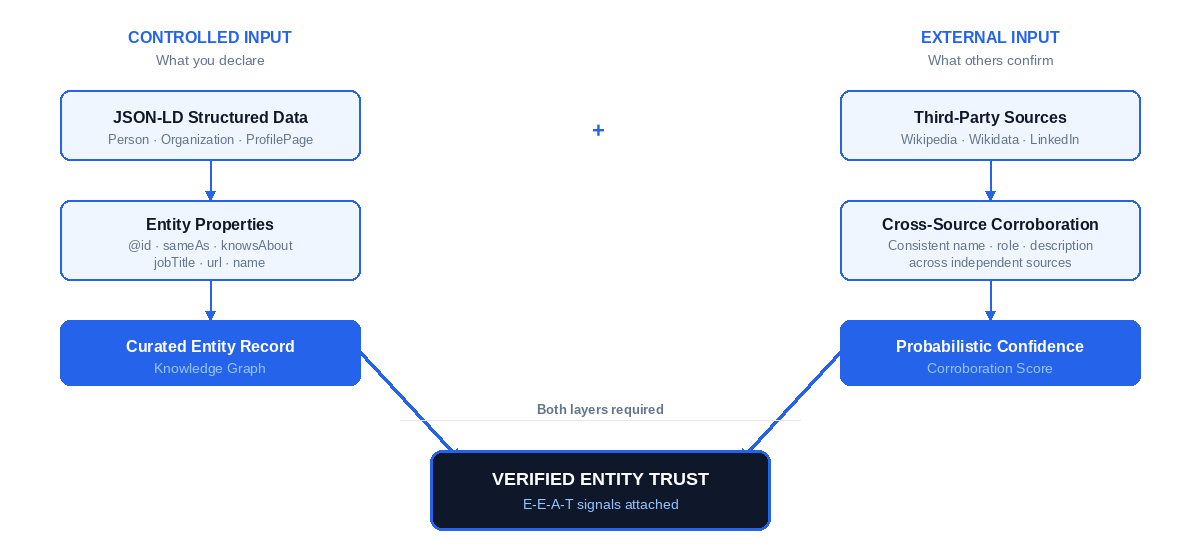
Structured data on your own site declares the entity. That’s necessary. But it’s not sufficient. E-E-A-T signals that exist only in your own markup don’t build corroboration confidence – Google can’t cross-reference a claim that appears in exactly one place. Third-party signals are what shift trust from “this entity claims expertise” to “multiple independent sources confirm this entity’s expertise.”
How Do You Implement Entity-Level E-E-A-T Signals with Structured Data?
Now the implementation. This section covers the JSON-LD that connects your content to a verifiable entity identity – Person schema for authors, Organization schema for publishers, and ProfilePage as the canonical container. Every property here is scoped to E-E-A-T relevance.
Person and Organization Schema – The sameAs Implementation
The sameAs schema property implementation is where entity identity becomes machine-readable. sameAs tells Google: “this entity is the same one described at these external URLs.” Each URL you provide is a corroboration point Google can check.
Start with Person schema for the content author. Identity properties alone – name, url – tell Google the entity exists. The E-E-A-T-relevant properties are what tell Google the entity is competent. jobTitle and knowsAbout carry “Experience” and “Expertise” signals – the first two E’s. Without them, your Person schema declares identity but not competence.
{
  "@context": "https://schema.org",
  "@type": "Person",
  "@id": "https://yoursite.com/#person-jaan-koppel",
  "name": "Jaan Koppel",
  "url": "https://yoursite.com/about/",
  "jobTitle": "Technical SEO Architect",
  "knowsAbout": ["Structured Data", "Schema.org", "Technical SEO", "Entity Optimization"],
  "sameAs": [
    "https://www.linkedin.com/in/jaankoppel",
    "https://x.com/jaankoppel",
    "http://www.wikidata.org/entity/Q123456789",
    "https://github.com/jaankoppel"
  ]
}
Replace the Wikidata QID (Q123456789) with your actual entity identifier. A dummy QID in production maps your entity to a nonexistent or unrelated concept in Google’s systems – the opposite of disambiguation.
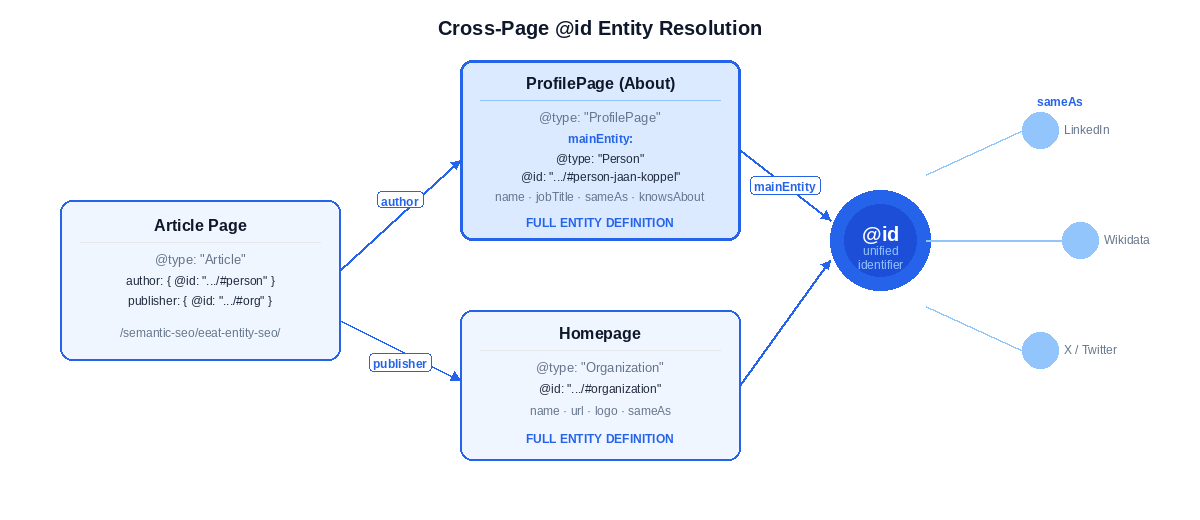
The @id strategy matters. Use a consistent pattern – https://yoursite.com/#person-firstname-lastname for single-author sites, or the full URL to an author profile page for multi-author sites. Mixing /#person shorthand on the homepage with a full URL on the about page fragments the entity. Every page that references this Person must use the same @id value. Pick one pattern and use it everywhere.
One safety net: always include url even when @id is present. When @id is absent, Google appears to use the url property on Person as a fallback identifier. Including both covers you.
Organization schema for the publisher follows the same logic, scoped to identity and corroboration properties only:
{
  "@context": "https://schema.org",
  "@type": "Organization",
  "@id": "https://yoursite.com/#organization",
  "name": "Squin",
  "url": "https://yoursite.com",
  "logo": "https://yoursite.com/logo.png",
  "sameAs": [
    "https://x.com/squinorg",
    "https://www.linkedin.com/company/squin",
    "http://www.wikidata.org/entity/Q987654321"
  ]
}
Same rule on the Wikidata QID – replace Q987654321 with your actual Organization entity identifier before deploying.
This isn’t the full Organization schema walkthrough. For Knowledge Panel optimization and complete property coverage, Organization schema picks up where this section leaves off. What’s here covers only the sameAs and identity properties that make Organization function as a trust signal.
Three sameAs rules that prevent implementation errors:
Use canonical URLs only. Every target profile should present consistent entity information – same name, same description, same logo where applicable. A sameAs link to a LinkedIn page that shows a different company name introduces ambiguity instead of corroboration.
Bidirectionality isn’t required in the way most guides describe it. You control your end – your schema’s sameAs points to external profiles. You can’t force Wikipedia or Wikidata to link back. Corroboration comes from consistent information across sources, not literal bidirectional hyperlinks. Your Wikidata entry’s “official website” property and your site’s sameAs pointing to Wikidata – that’s the practical pattern.
URI formats: Wikidata @id references use http://www.wikidata.org/entity/QXXXXXX – the canonical Linked Data URI. Wikipedia sameAs values use https://en.wikipedia.org/wiki/. Different URI schemes for different purposes. Using https:// Wikidata browser URLs in @id fields creates duplicate entity nodes in strictly-typed systems.
See the Schema.org sameAs property definition for the full specification.
ProfilePage Structured Data
ProfilePage structured data tells Google that a specific URL is the canonical profile page for a Person or Organization entity. Google added explicit support for ProfilePage markup – the Google documentation on ProfilePage describes it as a way to provide information about content creators.
The distinction: ProfilePage is the container. Person is the mainEntity. These aren’t duplicates – they’re different schema types doing different jobs.
{
  "@context": "https://schema.org",
  "@type": "ProfilePage",
  "dateCreated": "2024-01-15",
  "dateModified": "2025-03-10",
  "mainEntity": {
    "@type": "Person",
    "@id": "https://yoursite.com/#person-jaan-koppel",
    "name": "Jaan Koppel",
    "url": "https://yoursite.com/about/",
    "description": "Technical SEO Architect specializing in structured data, entity optimization, and semantic search.",
    "jobTitle": "Technical SEO Architect",
    "knowsAbout": ["Structured Data", "Schema.org", "Technical SEO", "Entity Optimization"],
    "sameAs": [
      "https://www.linkedin.com/in/jaankoppel",
      "https://x.com/jaankoppel"
    ]
  }
}
Deploy this ProfilePage markup on your dedicated author page or about page – whichever URL you use as the canonical profile for the entity. This is the page where the full Person definition lives. Other pages reference it by @id.
In the Rich Results Test, valid ProfilePage markup renders without errors or warnings. The mainEntity Person appears as a nested entity within the ProfilePage type. If you see the ProfilePage validated but no Person entity inside it, you’ve built a container with nothing in it. That’s a common mistake covered below.
Connecting Author to Content via Article Schema
Article schema’s author property references the Person entity by @id. This is the connection that ties individual content pages back to the entity trust profile.
The pattern: define the full Person entity once – on the ProfilePage or homepage. On every content page, reference it by @id alone:
{
  "@context": "https://schema.org",
  "@type": "Article",
  "headline": "E-E-A-T and Entity SEO: Build Trust at the Entity Level",
  "author": {
    "@type": "Person",
    "@id": "https://yoursite.com/#person-jaan-koppel"
  },
  "publisher": {
    "@type": "Organization",
    "@id": "https://yoursite.com/#organization"
  }
}
This is a simplified example showing only the author and publisher connection. Rank Math automatically outputs the remaining Article properties – datePublished, dateModified, image, url – so your live markup will be more complete than what’s shown here.
Both pages – the one with the full entity definition and the one with the @id reference – must be crawlable. If Google can’t reach the page where the full Person entity lives, the @id reference resolves to nothing. One limitation to keep in mind: the Rich Results Test validates a single page in isolation. It can’t confirm whether a cross-page @id reference actually resolves. To verify the connection, check that both pages are indexed in Google Search Console and that the full entity definition page renders its JSON-LD correctly on its own.
Rank Math generates Article schema automatically. The entity map layer – a PHP-based configuration that adds about and mentions properties tied to Wikidata entities – provides topical context on top of that output. The author reference connects who wrote it. The entity map connects what it’s about. See the Schema.org Person and Schema.org Organization specifications for the full property lists.
One note on structure: the standalone JSON-LD blocks shown above are simplified for clarity. Production sites often wrap multiple entity definitions – Person, Organization, Article, ProfilePage – in a single @graph array within one <script type="application/ld+json"> block. Rank Math outputs its JSON-LD this way by default.
With the implementation in place, the next step is verifying that Google actually reads these entity signals the way you intend.
How Do You Measure Entity Salience in Your Content?
Implementing entity schema is half the work. Verifying that your content actually reinforces those entities is the other half. Google Natural Language API entity salience gives you a direct measurement – a score from 0 to 1 indicating how central an entity is to a document. A score near 1 means the entity is the primary subject. Below 0.05, it’s a passing mention.
This verification step is easy to skip. Don’t.
Quick test with curl against the Cloud Natural Language API’s analyzeEntities endpoint:
curl -X POST \
  -H "Content-Type: application/json" \
  -H "Authorization: Bearer $(gcloud auth print-access-token)" \
  "https://language.googleapis.com/v1/documents:analyzeEntities" \
  -d '{
    "document": {
      "type": "PLAIN_TEXT",
      "content": "Jaan Koppel is a Technical SEO Architect specializing in structured data and entity optimization at Squin."
    },
    "encodingType": "UTF8"
  }'
The response returns each detected entity with a salience score, type, and any Wikipedia/Knowledge Graph metadata Google associates with it. For a single-page check, this is enough.
For batch checking across multiple URLs – the practitioner-level workflow – use the google-cloud-language Python library:
# Requires: pip install google-cloud-language requests beautifulsoup4
# Set GOOGLE_APPLICATION_CREDENTIALS env var to your service account key path
# before running. See cloud.google.com/natural-language/docs/setup for auth setup.

from google.cloud import language_v1
import requests
from bs4 import BeautifulSoup

def get_entity_salience(url):
    page = requests.get(url, timeout=10)
    page.raise_for_status()
    soup = BeautifulSoup(page.content, "html.parser")
    # Truncated to 5000 chars - salience scores may differ on longer pages.
    # The API accepts up to ~1M bytes, but shorter input keeps costs low
    # and is sufficient for a quick entity signal check.
    text = soup.get_text(separator=" ", strip=True)[:5000]

    client = language_v1.LanguageServiceClient()
    document = language_v1.Document(
        content=text,
        type_=language_v1.Document.Type.PLAIN_TEXT
    )
    response = client.analyze_entities(document=document)

    return [
        {"name": e.name, "salience": round(e.salience, 4), "type": e.type_.name}
        for e in response.entities
    ]

urls = [
    "https://yoursite.com/about/",
    "https://yoursite.com/semantic-seo/eeat-entity-seo/"
]

for url in urls:
    print(f"\n{url}")
    try:
        for entity in get_entity_salience(url)[:10]:
            print(f"  {entity['name']}: {entity['salience']} ({entity['type']})")
    except requests.exceptions.RequestException as e:
        print(f"  Failed to fetch: {e}")
    except Exception as e:
        print(f"  API error: {e}")
No hard threshold exists, but a practical benchmark: if your author entity or brand entity scores below 0.05 on pages where it should be prominent, the content isn’t reinforcing the entity signal. Increase entity mentions in prominent positions – title, first paragraph, headings. Add contextual sentences that define the entity’s relationship to the topic rather than just repeating the name.
For the full setup guide, authentication walkthrough, and automation workflow, see Google NLP API for SEO.
What Breaks Entity E-E-A-T Signals? Common Mistakes
Every schema type and property covered in this article has a failure mode. These are the ones that pass validation but break the trust signal.
sameAs pointing to dead or unclaimed profiles. Google follows those URLs. A 404 doesn’t just waste a corroboration opportunity – it introduces ambiguity. Worse, a sameAs link to a profile claimed by a different person actively conflicts with your entity declaration. Audit every sameAs URL quarterly. Profiles get deleted, usernames get recycled.
Organization schema deployed with no external corroboration. Your JSON-LD is technically valid. The Rich Results Test shows no errors. But the entity exists only in your own markup – nothing for Google to cross-reference. Structured data declares the entity. Without third-party mentions, directory listings, or a Wikidata entry, it’s a claim with no witnesses.
ProfilePage without a linked Person mainEntity. A container with nothing inside it. The Rich Results Test validates the ProfilePage type, but there’s no Person entity for Google to attach trust properties to. The markup is structurally correct and functionally empty.
Inconsistent entity naming across platforms. “Jaan Koppel” on the website, “J. Koppel” on LinkedIn, “jaankoppel” on GitHub. Each variation risks fragmenting into separate entity nodes. Google’s entity reconciliation handles minor formatting differences, but abbreviations and username-only profiles make reconciliation harder than it needs to be. Match the exact name value from your Person schema on every platform you control.
https:// Wikidata browser URLs in @id fields instead of http:// Linked Data URIs. The canonical Wikidata entity URI is http://www.wikidata.org/entity/QXXXXXX. The https://www.wikidata.org/wiki/QXXXXXX browser URL points to the human-readable page. In strictly-typed systems, these resolve as two different identifiers – creating duplicate entity nodes when you intended one.
Person schema with a name and nothing else. No sameAs, no url, no knowsAbout. Google gets an entity declaration it can’t verify and can’t attribute expertise to. Identity without corroboration or competence signals. The schema equivalent of an author byline with no author page.
Mixing @id patterns across pages. /#person-jaan-koppel on the homepage, https://yoursite.com/about/ as the @id on the about page, no @id at all on blog posts. The entity fragments because there’s no consistent identifier tying the references together. One @id value, every page, no exceptions.
FAQ – E-E-A-T and Entity SEO
Is E-E-A-T a direct ranking factor?
No. E-E-A-T is an evaluation framework from Google’s Search Quality Rater Guidelines, not an algorithmic ranking signal. Google’s systems look for signals that correlate with E-E-A-T – author reputation, source credibility, entity corroboration across independent sources – but E-E-A-T itself isn’t a score in the algorithm. Google’s documentation on creating helpful content addresses this distinction.
How does schema markup help with entity recognition?
Schema markup in JSON-LD declares entities – Person, Organization – in a format Google can parse directly. Without it, Google infers entities from unstructured text. That inference is slower and more ambiguous. Schema makes the entity declaration explicit and links it to canonical identifiers through sameAs. The difference: implicit entity recognition versus explicit entity declaration.
What is the difference between E-E-A-T and entity SEO?
E-E-A-T describes what Google evaluates – experience, expertise, authoritativeness, trust. Entity SEO describes how to make those signals machine-readable through structured data, disambiguation, and Knowledge Graph alignment. E-E-A-T is the evaluation framework. Entity SEO is the implementation layer that feeds it.
How do I get my brand into the Google Knowledge Graph?
No guaranteed method exists. But consistent structured data (Organization schema with sameAs), a Wikidata entry with sourced claims, third-party mentions on authoritative sites, and a Wikipedia article (if your brand meets notability criteria) all contribute. The Knowledge Graph Search API lets you check whether Google recognizes your entity.
Can AI-generated content have high E-E-A-T?
E-E-A-T attaches to the author and publisher entities, not the production method. If a recognized expert publishes AI-assisted content under their verified entity profile, Google evaluates that entity’s trust signals. Content with no identifiable author entity struggles with E-E-A-T regardless of how it was produced.
Where This Fits
This article covers one layer of the semantic SEO framework – making E-E-A-T signals machine-readable through entity-level structured data. For the foundational concepts behind entity recognition, see entity disambiguation. For the full publisher schema walkthrough, Organization schema picks up where the implementation section leaves off.